Condition determines a typewriter’s value more than age, rarity, or brand. Not “matters more.” Determines. A common Smith-Corona in excellent shape will out-earn a rare machine with a frozen carriage and a coat of rust, almost every time.
If you take one thing from this post, take that. I wish someone had spelled this out for me before I started collecting. I learned it the hard way.
Why Condition Is King
Fixing a broken typewriter often costs more than it’s worth. Specialized tools, donor parts that are hard to find, labor from a professional who can be equally hard to find, and who probably isn’t cheap. Pay $40 for a “project machine” and you can easily sink $300 into it before it types a clean line.
That math rarely works out in your favor.
Most people buying typewriters today want to use them, not display them. A typewriter that can’t type is just a paperweight that takes up a shelf and does nothing.
There’s a quieter reason underneath. Fewer people can actually fix these machines than could ten years ago. Nobody tracks the number for typewriters specifically, but the broader repair trades do: 2026 industry data puts the ratio at roughly two younger technicians entering the field for every five retiring.
Typewriter repair shops used to be a given in any city of size. Now you’re more likely to ship the machine somewhere than carry it in yourself.
As a new collector, plan on doing some of this work yourself. Learning basic maintenance and repair isn’t as hard as it sounds. The Typewriter Database publishes model-specific repair reference books, and YouTube has walkthroughs for almost anything you’d need from ribbon changes to stuck carriages, up to a full teardown if you’re feeling brave.
What Bends the Rule
Two things are worth letting override condition:
The first is genuine rarity. Collectors will tolerate damage on a rare machine, because a working example and a badly damaged one are both extraordinarily hard to find, and the gap between what’s out there and what you could actually buy is small either way.
The second is about who owned the machine, and whether that ownership is documented rather than implied. Cormac McCarthy’s Olivetti Lettera 32, the one he wrote most of his novels on, sold at Christie’s in December 2009 for $254,500, roughly ten times the auction house’s high estimate. It sold for a premium price because of what was typed on it.
Neither exception applies to almost anything Average Joe or Jane collector will actually find or afford, but still worth knowing they exist. Not worth using as an excuse for the beat-up machine in front of you that has neither rarity nor a documented owner going for it.
Grading a Machine
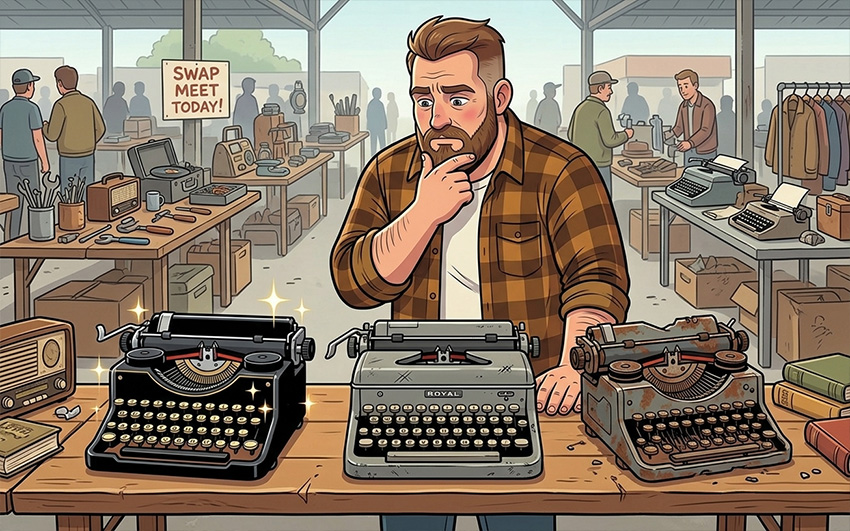
Collectors generally sort condition into four tiers, and it helps to know the vocabulary before you’re seeing a listing in person for the first time, trying to decide what “barely used” is supposed to mean.
Mint / Pristine looks and functions like it left the factory yesterday. Original case, manual, and accessories present. No rust, no paint chips.
Excellent / Working has minor cosmetic wear but full mechanical function. Clean segment slots, keys that snap back the way they’re supposed to and don’t stick.
Project / Parts means heavy rust, a frozen mechanism, missing keys, or a damaged carriage. These get bought cheap, mostly for parts, not for a future as a writing machine.
Then there’s the tier above all of them, the one you’ll almost never see and should recognize immediately when you do: New Old Stock. Picture a shop in 1978 that ordered ten of some portable from the factory, sold nine, and pushed the tenth box to the back of a shelf, where it sat forgotten until the shop finally closed decades later. That box, still sealed, is NOS. Nothing about it is vintage in the way the machine’s age would suggest. It’s new. It just happened 50 years late.
What to Check Before You Buy
If you can put your hands on the machine before you commit, do. Bring a sheet of paper. Roll it in and type every key, not just a sentence to see if there’s ink left in the ribbon (there rarely is). Sticky keys are common and usually fixable, but you want to know about them before you’re negotiating, not after you’ve paid.
Run the carriage to both margins and back. It should glide freely and not catch. Pull the paper release and check that the platen actually grips. A hard, glassy platen won’t feed paper evenly no matter how good everything else feels. Use the carriage return. If the machine has a line spacing selector, make sure that works also.
In other words, look the machine over carefully first. This is the part people skip because testing something in a stranger’s garage while they look over your shoulder feels rude. It isn’t. It’s the only way to know what you’re actually buying instead of taking the seller’s word for it.
If you’re buying online instead, “100% working” in a listing means something specific. Anything short of that, “as-is,” “untested,” “I don’t know much about it,” means you’re buying blind, and the price should reflect that you are.
Where to Look
Facebook Marketplace, eBay, Etsy, Goodwill Online, thrift stores, garage sales, estate sales, and, if you’re lucky enough to have one nearby, a local repair shop that sells machines they have fixed.
Craigslist deserves a specific mention, because most people search it wrong. Skip the site’s own listings page and run a Google search for the model plus site:craigslist.org. Type “1952 Underwood site:craigslist.org” into Google and you pull listings across every regional Craigslist site at once, instead of scrolling one city at a time hoping something turns up. Just a small trick.
Before committing to a listing, ten minutes of research saves regret later. The Classic Typewriter Page, run by Richard Polt, is the standard reference for manufacturer and model history. Once you have a serial number in hand, the Typewriter Database will date the exact machine, not just the model line. For more texture, try the other Typosphere links in the sidebar on this page.

Weight matters if you’re having a typewriter shipped. Most models are heavy enough that careless handling turns into real damage. Something that survived 60 years in a closet won’t always survive a few days on a FedEx truck.
Sellers who ship typewriters regularly know how to pack them: foam in the right places, the machine immobilized inside the box, etc. That’s not zero risk, but it’s a lot less risk than whatever a first-time seller throws together with a roll of tape and some newspaper. Check the seller’s history. Make sure they’ve shipped plenty of typewriters before buying from them.
Typewriter Market Trends
Analog is fashionable again, and typewriters are riding the wave. Letter writing, typewriter clubs, and calligraphy groups have become a documented way people are stepping back from their phones.
Prices reflect the resurgence in popularity. A 2013 buying guide told readers a common postwar machine should cost $25 or less, and that paying more was “a waste of your money.” That advice is close to useless today. Most usually run $100 to $300, and a professionally restored machine starts there and can climb well past $1,000 for a desirable model.
Good deals still exist, you just have to be patient. A lot of sellers base their pricing off what they see on eBay or Etsy. Those are asking prices, not sold prices, and the gap between the two can be pretty wide. Most platforms also let you search by “sold.” If you’re interested in a particular model, take a look at what they’re actually selling for so you don’t overpay.
Most sellers will negotiate, and how long a listing’s been up tells you how much wiggle room you actually have. A machine posted three weeks ago has more give than one posted yesterday. Avoid making a lowball offer early on, which usually kills the deal instead of starting one. Let the listing age, then make a real offer.
Availability isn’t the same across the country either. I see Smith-Coronas and Royals for sale everywhere here in Ohio and can go months without a decent Olympia showing up in my feed. Someone shopping the same platforms from a coastal city might have the exact opposite experience. Check regional groups and local listings for whatever model you’re after specifically. National trends don’t always apply to what’s actually obtainable near you.
Buzzwords & Buyer Traps
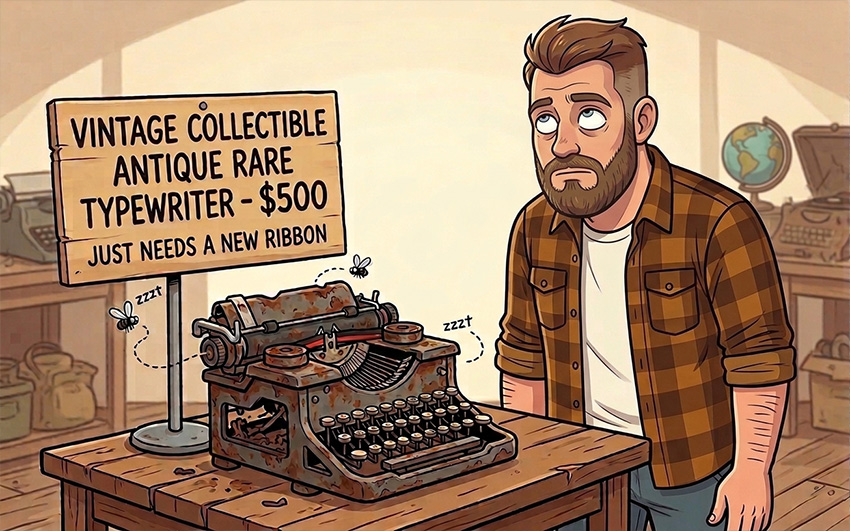
Sellers use buzzwords to increase perceived value. Vintage. Collectible. Antique. Rare. Most people using these words on a listing are flipping a machine they found, not people who understand typewriters. The words are doing work the machine’s actual condition should be doing instead. “Just needs a new ribbon” is close to a meme in the collecting world, wheeled out to describe typewriters that need a great deal more than a ribbon.
“Recently serviced” gets abused the same way. Ask what that really means. If it was professionally serviced, ask to see the receipt. A lot of what passes for “service” is a seller spraying WD-40 into the segment and calling it done. WD-40 isn’t a lubricant, it’s a water dispersant, and inside a typewriter it attracts dust, congeals, and can seize a mechanism instead of freeing it.
Another trap is different, and newer. Modern reproduction typewriters get sold as if they belong to the same market as the real thing. The most visible one right now is the Royal Classic, manufactured in China, with no actual connection to the historical Royal Typewriter Company beyond a name chosen to confuse buyers. It shows up on Amazon and sometimes in big-box stores.
“Rare” is the buzzword most likely to actually work on you. Most models built after WWII weren’t scarce, they were mass produced. Olympia built more than 800,000 SM3s in just four years. IBM sold over 13 million Selectrics before retiring the line in 1986. These are common objects by any reasonable definition, not endangered ones, no matter what a listing title says.
None of that means a specific typewriter color, typeface, or condition isn’t genuinely hard to find. A mint condition SM3 in a color you like can be a real search problem, and there’s nothing wrong with caring about that. But it’s not rare in the sense the word is supposed to mean. A seller reaching for “rare” on a machine built by the hundreds of thousands is just trying to create a false sense of urgency. Scarce-to-you and rare-in-fact are two different claims. Pay close attention to which one you’re actually being sold.
You’ll Still Get It Wrong
This doesn’t make you immune. Follow every guideline above, check every box, read every seller’s word choice with total suspicion, and you’ll still eventually bring home a machine that disappoints you. That’s just the reality of buying anything you can’t fully evaluate until you’ve lived with it a while.
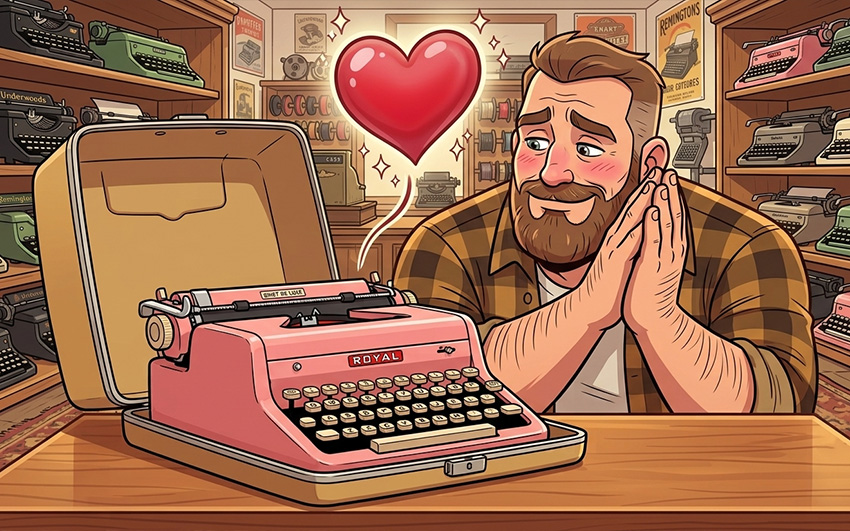
Here’s the part that complicates it further. The machines people end up loving most are rarely the ones they researched hardest. Ask other collectors and you’ll hear some version of the same story: came across a pink Royal they had never thought about before. It was beat up, the “B” key was sticking, and it was way overpriced. Bought it anyway.
I said at the start that I learned most of this the hard way. That’s true. I’ve broken every rule at least once, and I’ll probably break some again before the year’s out. The rules aren’t wrong. They just aren’t the whole story, and the exception is usually the machine that ends up being your favorite.