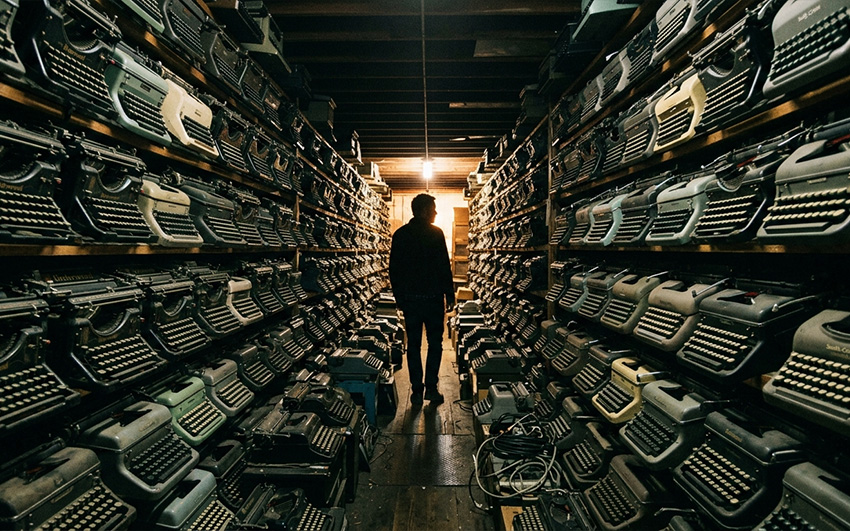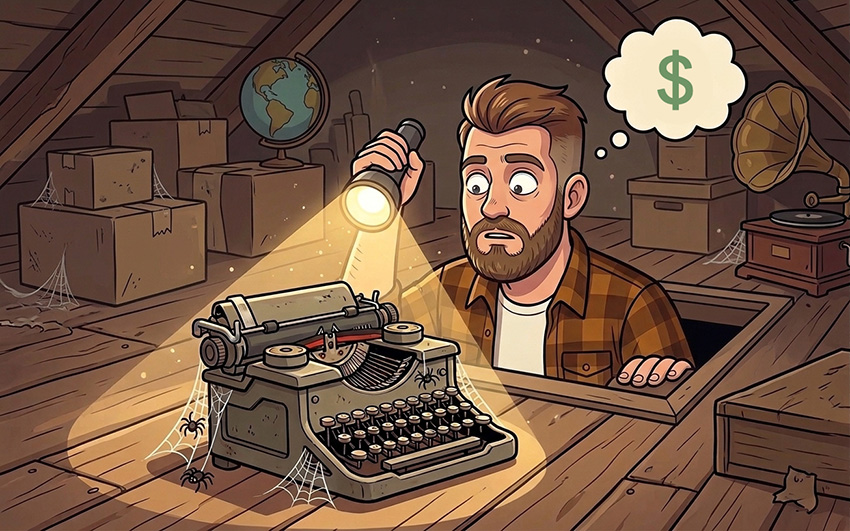
So you found an old typewriter in grandma’s attic. Or maybe you came across one for cheap at a garage sale and you want to know if you can make a few bucks by relisting it on Facebook Marketplace.
Before getting into what it’s worth, first figure out what you have.
The manufacturer name is usually the easy part. It’s stamped on a badge, front and center, shiny enough to catch your eye: Smith-Corona, Royal, Olympia, Remington. The model is also usually printed on there. Sterling, Quiet DeLuxe, or Streamliner, to name a few. These aren’t always as obvious. And some manufacturers never put it on the machine at all.
One thing you’ll never find on the machine itself is what year it was made. For that, you have to dig a little.
Every typewriter has a serial number. It’s stamped into the metal frame: under the cover near the ribbon spools, under the roller carriage, or on the underside. It can be hard to find on some models, but it’s there. You may need a flashlight to find it.
Once you have the serial number, go to The Typewriter Database and enter the manufacturer name in the search bar. You can figure out the rest from there. Once everything matches, browse photos of the exact model to confirm you’ve got it right.
Here’s your first lesson. Your listing gains more attention when you’re specific. “1949 Royal Quiet DeLuxe” is much better than “Antique Typewriter.”
What Drives Value
No model has a fixed dollar value. For someone to say that a 1953 Smith-Corona Sterling is worth $175, they’d be wrong before they even finished the sentence. The old rule still holds:
“A thing is worth what someone is willing to pay for it.”
The price of an item is set by open market demand, not what it cost to make or what the owner hopes to get. As of late 2026, when this was written, typewriter demand is up, and that works in your favor as a seller.
The biggest variable in what a machine sells for is your location. I’m in Ohio, and the average purchase price for a typewriter on Facebook Marketplace here runs about $150. Notice I said purchase price. We’ll get into the difference between listing price and sold price later.
Smith-Corona Sterling models, any year, are still popular, and you can find one for sale almost anywhere in the country. List that exact same typewriter in Ohio, Georgia, California, and Iowa, and you’ll get four different results. Same machine, four numbers.
With that in mind, here are the other main factors that determine what your typewriter is worth:
Condition
Condition is king. A common model in good, working condition is worth more than a rare model with jammed keys, chipped paint, and a coat of rust.
Read that again. If you take nothing else away from this post, take that.
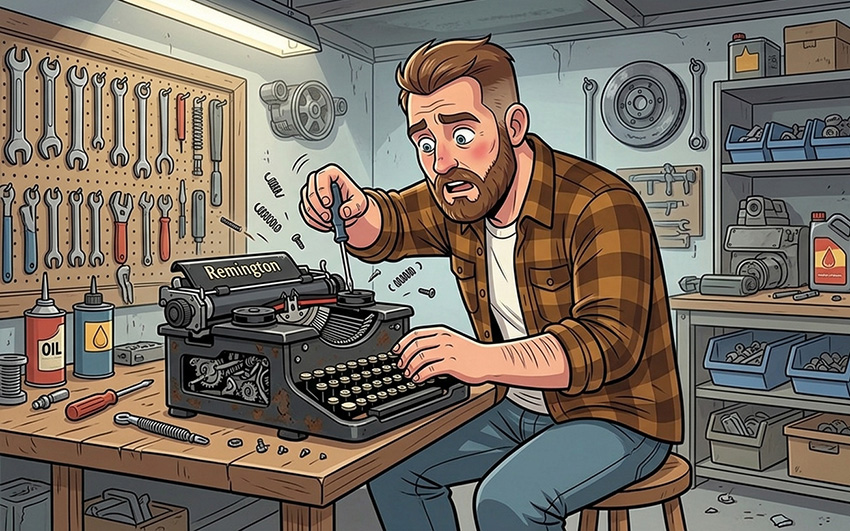
The reason isn’t aesthetics, it’s logistics. Most people don’t have a repair shop anywhere near them. A simple cleaning is about the ceiling of what someone can do themselves. Past that, it takes real knowledge, the right tools, and patience. Someone with all three is hard to find and never cheap. The restoration bill on a rough machine will usually run past what it’s worth.
As a seller, this is where you start:
- Does the machine work?
- Do the keys move freely, or do they stick?
- Does the carriage return slide back and forth clean, or does it grind, or not move at all?
- Is it just a cleaning job, or are parts broken or missing?
- Is the case in good shape, and does it still close and lock properly?
Extras add value too: the original manual, a receipt, any paperwork that shipped with it. Many typewriters left the factory with a small maintenance kit, brush included, and most of what’s still around sixty-plus years later doesn’t have it anymore. If yours does, that’s an edge buyers will notice.
Ultimately, buyers want a machine that works.
They’ll overlook a few scratches and a case that’s seen better days. What they won’t tolerate is sinking $300 into it just to get it typing again. However, beat-up doesn’t mean worthless. Repair shops buy project machines all the time, and even the ones too far gone to save get bought and stripped for parts.
Typeface
Most typewriters shipped with one of two standard typefaces (fonts): Pica or Elite. Elite runs a little smaller than Pica, but otherwise looks about the same, and it’s what most people picture when they think about how a typewriter prints. Some manufacturers, like Olympia, offered several alternate typefaces. Others offered almost none.
A machine with an unusual typeface is more desirable than the same model in standard type, and some buyers even prioritize typeface over model. Cursive/script are the most sought after. Techno/modern-style faces come in second.
Photograph a clean typing sample for your listing instead of just naming the typeface. A description is easy to skip past. A typed sample proves the machine is what the listing says it is, and a buyer shopping by typeface will look for it before looking at anything else.
Size
Typewriters fall into three basic categories, and knowing which one you have changes who’s going to want to buy it.
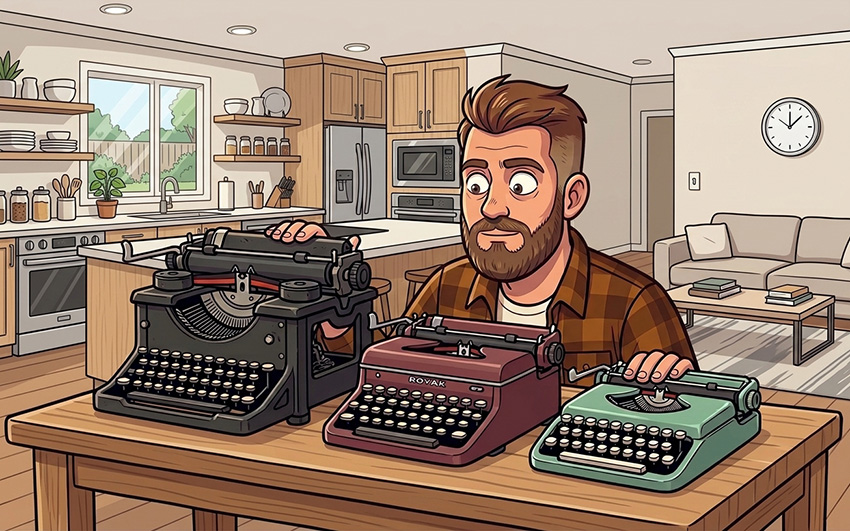
Desktop typewriters: These are the large ones, usually 25-40 pounds or more, built to sit in one place and stay there. They’re lovingly referred to as “boat anchors” in the collecting world. That weight shrinks the buyer pool fast. Not many people today have the space for a machine that size. What you get in return is real stability, a smoother and faster key touch, and a more ergonomic typing height.
Portable typewriters: Also called “suitcase typewriters,” since they ran about half the size and weight of a desktop and came with their own carrying case. This category is where most of the buying and selling happens. They kept most of the same features as their desktop cousins, built into something a person didn’t have trouble moving around.
Ultra-portable typewriters: The smallest of the three, with some standing less than three inches tall. Street poets and writers who travel favor them for exactly that reason. What they gain in portability, they give up in features, and the compact inner workings can make them quirky to type on.
None of these categories is more rare or valuable than the others.
Colors & Features
Typewriters are utilitarian machines built for office work, and businesses wanted black, gray, or brown machines that didn’t distract from the job. That changed in the 1950s. Manufacturers started offering bright colors like blue, green, pink, and red. Smith-Corona in particular was known for its colorful machines. Put two similar models side-by-side and the pink one sells faster than the black one, almost every time.
Buyers will pay a premium for color. Beyond that, what a buyer looks for is largely a matter of personal preference.
1950s-era machines, the mid-century modern ones, have rounded corners and chrome accents. A look that tends to pull in the most buyers. Others want something older: machines with keys capped in real glass instead of plastic.
Features varied by price point when these machines were new. Budget models skipped the creature comforts that top-of-the-line models had. Those extras still carry value today. A typewriter with touch control, tab settings, and a full keyboard is generally worth more than a basic model in the same condition.
Rarity
Almost all typewriters manufactured after WWII were mass produced, some by the millions. A huge chunk of what they made survived because these machines were built to last several lifetimes. There’s a 99% chance the machine you’re selling is not rare. Just because it’s old doesn’t make it rare.
This misconception costs you in two ways. First, believing your machine is rare inflates its value in your head before you’ve even listed it. Second, dropping the word “rare” into a listing to juice the price backfires when a buyer reading it just scrolled past three other typewriters just like yours.
“Desirable” is a better word than “rare.” Mixing them up is the most common error a seller makes.
Next Steps
You’ve determined what you have, and it’s in good enough shape to sell. The next move is searching online to see what it might sell for. This is where sellers make their second big mistake. Confusing asking price and selling price.
You’ll search the usual suspects: eBay, Etsy, Craigslist, Facebook Marketplace. You may even wander onto a few typewriter repair shop websites. And you’ll find outrageous prices. Some past a thousand dollars.
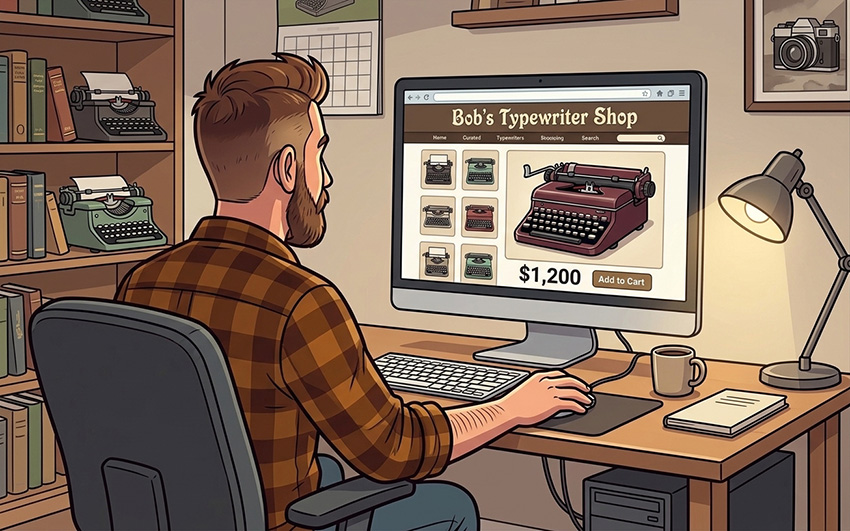
The highest prices, by a wide margin, come from retail typewriter stores. “Professionally serviced” means exactly what it sounds like: someone who knows what they’re doing has gone through the machine from top to bottom. They’ve deep-cleaned it with chemicals harsh enough to cut through decades of gunk, and repaired everything that needed it. That level of service commands a premium price.
It doesn’t mean your typewriter is worth that much.
Expectations vs. Reality
eBay and Etsy show a wall of typewriters priced at three hundred dollars, four hundred, more, and the number reads like a fact. Anyone can enter any price into a listing and hit publish.
A garage sale has a clock running. Whatever doesn’t sell by five o’clock goes back in the closet, or to Goodwill, and that pressure keeps prices honest. An online listing has no clock. It can sit at $400 for six months and cost the seller nothing but a little scroll-past traffic. A good share of what shows up in an online typewriter search has been sitting for a while. Unsold, unnegotiated, still priced at a number nobody’s agreed to pay.
eBay will actually tell you a more accurate number, if you know where to look. Filter a search to “sold” listings instead of active ones, and the picture changes. A machine asking $400 might sit next to an identical model that sold, paid for and shipped, for $250. That $250 sale is the real number. The $400 listing is still just a hope.
A Word on Shipping
The typewriter you found at the back of Nana’s closet didn’t have to endure much. Tucked away safely in its case, the most it had to fight off was rust from changes in humidity. The odds of it surviving a cross-country trip on the back of a FedEx truck aren’t good, and it’s a bet I’d advise you not to take.
Selling locally means fewer eyes on the listing. That’s the honest trade. A listing on Facebook Marketplace or local buy/sell group reaches a few thousand people instead of the millions scrolling eBay, and your machine that might move in a day nationally could take a week or two locally instead.
What it buys you in return is certainty. A local buyer can come look at the machine, type on it, hear it, and hand over cash on the spot. No box, no packing peanuts, no insurance claim because a driver dropped it on a porch. The typewriter that leaves your hands is the exact one that arrives, because it never left your hands until someone else’s were already on it.
There’s a mechanical reason shipping is riskier than it looks, too. These machines were built heavy for a reason: cast iron frames meant to sit still on a desk, not tipped upside down in a truck for three days. The parts that do the typing are precision-fitted and meant to move freely. A hard jolt doesn’t have to crack the case to do damage. It can knock the mechanism out of alignment, and a typewriter that looks perfect in the box can arrive typing crooked lines, or not typing at all.
None of that is free for the seller, either. A buyer who opens a box to a jammed carriage or bent typebars wants a refund, and now the shipping cost, the time, and the sale are all gone at once. A local sale for less money still beats a shipped sale for nothing.
Alternatives to Selling
This doesn’t have to end in a sale at all.
A couple hundred bucks is real money, but it isn’t much money, and it might be worth less to you than a machine that already works and already sits on your desk.
Typewriters are having a real moment right now. People are dragging machines out of closets that have sat there for decades, not to sell them, but to write on them, and there’s a reason beyond nostalgia. A typewriter doesn’t track what you’re doing. It doesn’t autocorrect a sentence into something you didn’t mean, and it won’t let you fix a bad paragraph before you’ve finished writing it, which turns out to be the appeal for a lot of new users. The page in front of you is the only thing happening.
If you’re even a little curious, the machine found in a closet is a head start most people don’t get. Buying into this hobby usually means learning what to look for, what to avoid, what a fair price looks like. You skip all of that. It’s already yours, it already works, or it’s close enough that a cleaning and a new ribbon gets it there. Consider keeping it for yourself.
Make a Donation
Goodwill will always take it. That’s the easiest answer here if you just want to get rid of it. The machine gets a second life, you get a receipt for the tax deduction, and somebody who wanders in looking for something to type on again finds it there.
A classroom is even better. Teachers running creative writing units have been asking for typewriters for a while now, mostly because a typewriter forces a different kind of attention than a laptop does. A working portable that would sell for a hundred dollars is worth more than that to a teacher who’s been asking around for exactly this and hasn’t found one.
Finding that teacher is easier than it sounds. A local Buy Nothing group, a parent Facebook group for an elementary or middle school, or a quick email to a school’s language arts department usually gets an answer fast. A typewriter that could take weeks to sell on Marketplace can be gone in a day once the right classroom hears about it.
The Selling Formula
If you’re still set on selling it, here’s the formula I use:
- Determine the make, model, and year of your machine.
- Research what similar models are selling for in your area.
- This is your baseline. Let’s say that number is $150.
- Add or deduct dollars for condition, features, color, etc.
- Profit.
Number four is the tricky one. Let’s say your machine is in great shape, better than anything else listed in your area, and it has a script typeface. How do you assign a number to that?
Easy. You wing it.
Typeface is worth real money, so I’d list that machine at $300 without blinking. Most buyers will try to negotiate a better deal anyway, and the price always goes one way. Down.
Flip it. Say your machine isn’t in the best condition. Now what? Condition is king, remember, so you’re taking a hit on price no matter how cool the typeface is.
That’s as close to a formula as you’ll get, and it’s permission to guess with information instead of just guessing. Nobody selling a typewriter needs to get the number exactly right. They need to get it close enough that eyes look at the listing and don’t scroll past it.
List it, watch what happens, and adjust if it sits. The market is always going to tell you the real number eventually. Your job is just to give it something to react to.
Good luck!