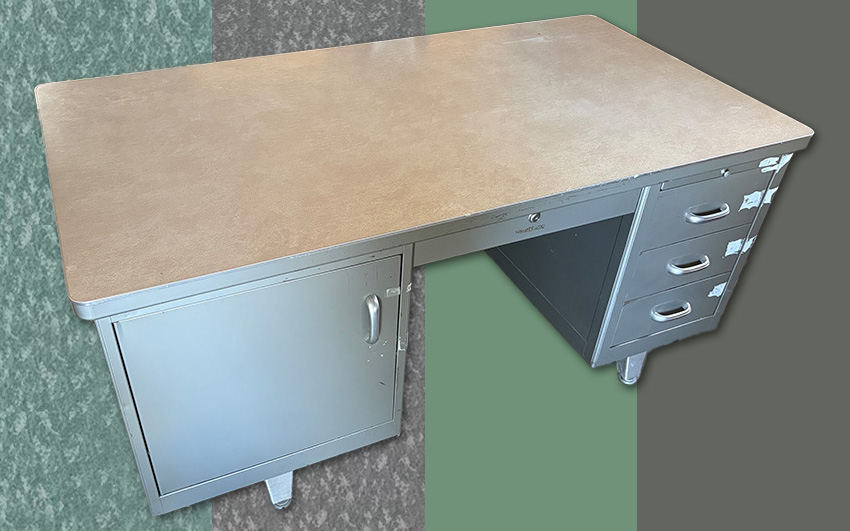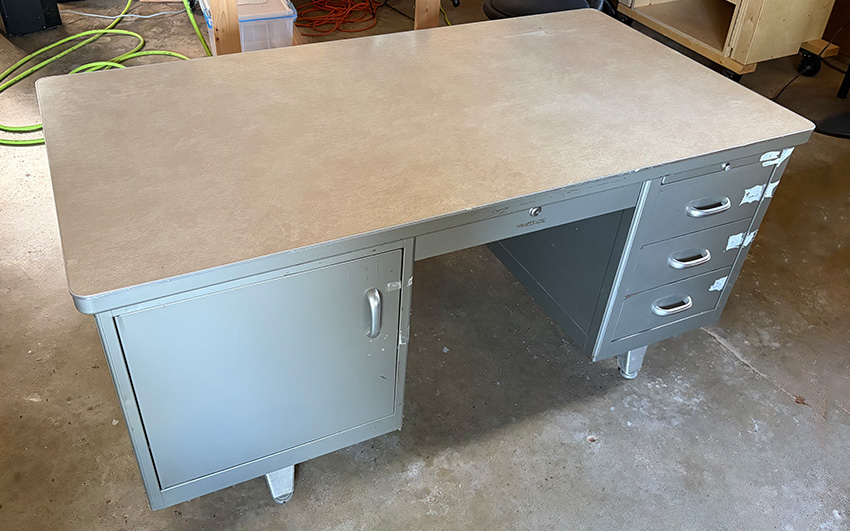
Before I get into the restoration itself, the desk deserves some context. Where it came from, who made it, and why a company that started out selling index cards ended up building one of the most recognizable pieces of office furniture in American history.
From Index Cards to “Built Like a Skyscraper”
Shaw-Walker started small. In 1899, two young entrepreneurs, Arch W. Shaw and Louis C. Walker, set up shop in a corner of the Muskegon Opera House in Muskegon, Michigan, with a modest amount of capital and a simple idea: 3×5 index cards, printed and cut in-house, sold as part of a filing “system” housed in small wooden cabinets. It was an unglamorous business that quietly became essential once offices realized they couldn’t function without it.
The company grew fast. Within a few years the product line expanded into wooden filing cabinets, desks, and general office furniture, and by 1903 Shaw had split off a publishing arm to produce a house magazine called Systems, aimed at teaching businesses how to organize their paperwork. That magazine eventually became Business Week.
A turning point came in 1913, when Shaw-Walker introduced its first all-steel filing cabinet under the slogan “Built Like a Skyscraper,” tying the product to the era’s fascination with steel-frame construction and vertical engineering. By the time they introduced a dedicated steel desk line in 1929, followed by a redesigned “low desk” in 1937 with a more comfortable 29-inch working height, steel furniture had become the standard for modern offices.
Where the Tanker Desk Comes From
The style my desk belongs to, the steel “tanker” desk, hit its stride from the 1940s through the 1970s. It’s a recognizable shape: two stacked banks of drawers acting as pedestals, a shallow center drawer, and a flat rectangular top, all welded from heavy-gauge sheet steel with rounded corners and a riveted, almost hull-like construction.
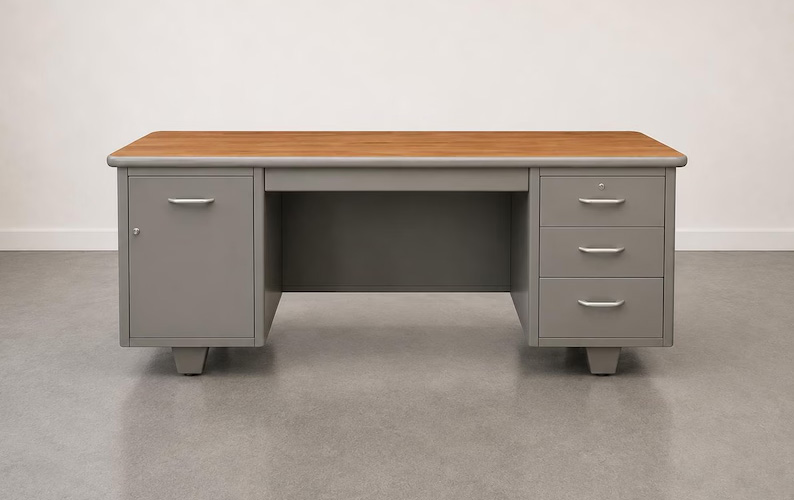
Shaw-Walker wasn’t the only company making them. McDowell-Craig, Steelcase, Allsteel, General Fireproofing, and Art Metal all produced their own versions during the same stretch, and collectors today tend to sort tanker desks by manufacturer the way typewriter nerds sort machines by maker. The exact origin of the “tanker” nickname isn’t something I’ve found documented in any definitive source.
What is well documented is why steel desks like this became so common in the first place. Steel manufacturing capacity had expanded to meet wartime demand, and postwar offices, schools, and government buildings wanted furniture that was cheap, fireproof, and close to indestructible. You genuinely cannot kill one of these desks with normal use. It takes decades of neglect, rust, and bad paint.
Why This One Is Interesting
Most tanker desks were also modular. The two pedestals were just hollow shells that could be customized with banks of drawers, a large open cabinet, or what I was specifically looking for: a spring-loaded shelf that swings out from inside the body of the desk, built to hold a typewriter at working height and then tuck it away out of sight when you’re done.
Today, tanker desks are obsolete. The ones that survived being sold off for scrap have found their way out of the office completely and just take up space in storage units and corners of dusty old barns.
They’re still not hard to find, and come in two varieties. The cheap or free ones are usually beat up and need a lot of sweat equity to restore them. The ones in good condition often sell for over $300. I found a tanker desk that was in excellent shape, and best of all, it was free.
Next up: what the desk actually looked like when it arrived, and everything wrong with it.