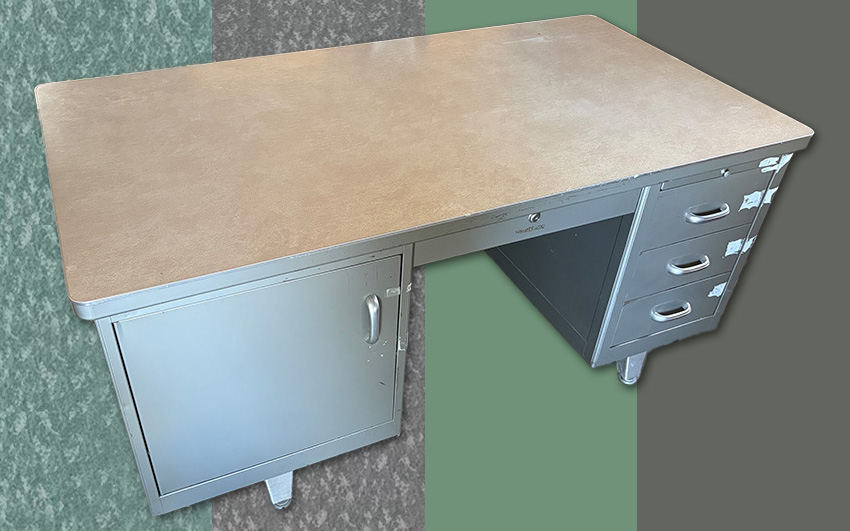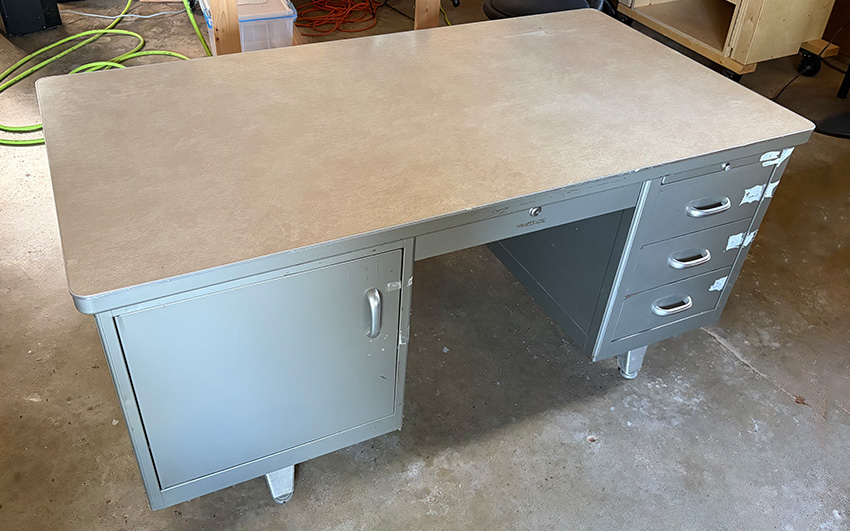
This desk came from my boss. It spent years sitting in his late father’s garage, just taking up space. His dad never threw anything away, and this summer my boss filled five dumpsters clearing the place out. I’m glad the desk survived long enough for me to give it a second life.
Free is free. But a desk that sits forgotten over the years usually earns every bit of neglect that implies, and I went in expecting to spend a full week with a wire wheel, sanding through bad paint down to bare steel.
Everything Wrong With It
Not much, as it turns out.
The laminate top is in great shape. No dents or gouges in the metal to pound out with a hammer. The drawers had been duct-taped shut, so it will take some time to scrape off the leftover goo. The worst of it is the legs, which all have heavy scratches from decades of beatings from a vacuum cleaner.
Most of the damage is just cosmetic.
Why a Tanker Desk?
I’ve been drawn to mid-century modern design longer than I’ve been collecting typewriters. This desk is the reason the two finally overlapped.
A lot of what gets sold as mid-century modern now is reproduction furniture: veneer over particleboard, built to evoke the look rather than survive anything stronger than a hard sneeze.
This desk was built during the actual era, out of actual steel, for an office that expected to use it hard for decades. That’s the difference between an aesthetic and a design philosophy. It’s the reason I wanted a real one instead of something built last year to look like one.
What’s Inside
The two pedestals do completely different jobs.
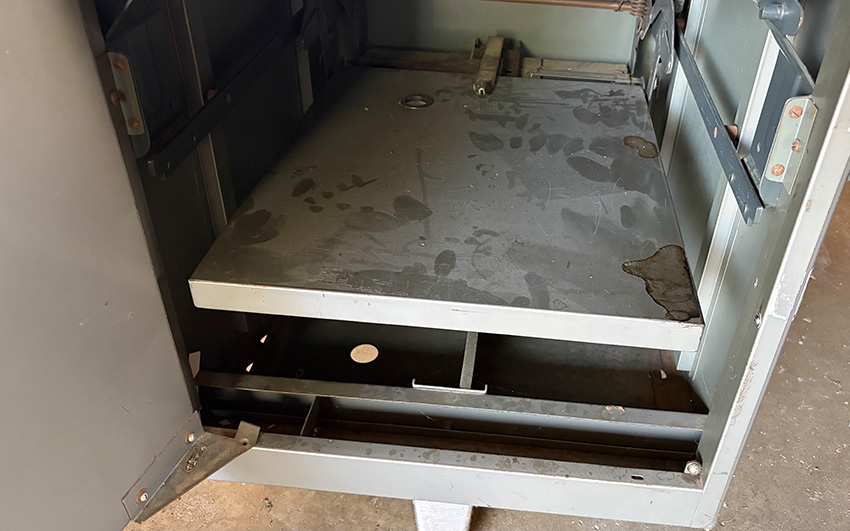
The left cabinet has the feature I was specifically hunting for: a spring-loaded shelf that swings out from inside the body of the desk, built to hold a typewriter at working height. Push it back in when you’re done, and it disappears.
A keen eye will detect the small pass-through hole in the shelf, indicating this desk was built during the electric typewriter era. That hole is for the power cord.
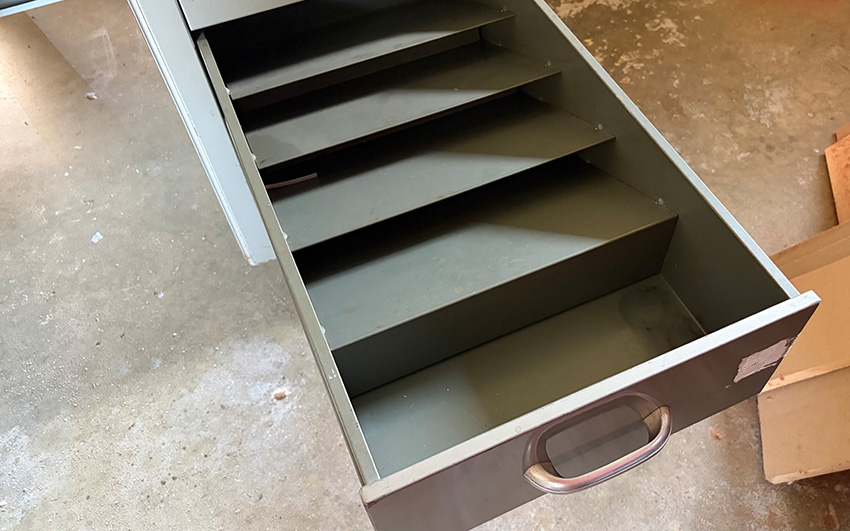
The right cabinet is a bank of drawers. The middle drawer has a built-in organizer with divided sections for paper and stationery, a factory-fitted detail nobody bothers designing anymore because nobody designs a drawer around what’s supposed to go in it anymore.
The Paint Problem
I wanted Rust-Oleum’s Verde Green in the hammered finish, which would’ve looked fantastic with the laminate top. Apparently, it’s discontinued. Grey hammered finish is the replacement. Less personality than the green would have had, but it will work.
Next up: tearing it down and finding out if all those years in storage left anything under the paint that the desk isn’t telling me about yet.