The Kolibri’s flat profile didn’t start with this machine. In October 1936, an engineer named Leopold Ferdinand Pascher filed for a typewriter design he described as one “which can be carried in a small envelope.” That patent became the Gromina, the Kolibri’s predecessor, and it sat unbuilt through the entirety of WWII.
Pascher didn’t live to see it made. He survived the fighting and was then captured by Soviet forces, and died in a camp around 1946. The Gromina finally went into production in 1951, after Groma reorganized its manufacturing under new East German ownership. His family collected royalties on it afterward.
The Kolibri followed a few years later, a further development of Pascher’s idea credited to an engineer named Karl Ronneberger, working under the company’s new name: VEB Mechanik Groma.
A State Company, Selling West
Groma itself started as Maschinenfabrik G.F. Grosser, a sewing machine maker in Markersdorf, on the river Chemnitz, the source of the brand name. After the war, in the Soviet-occupied zone that became East Germany, it was nationalized into VEB Schreibmaschinenwerk “Groma,” a Volkseigener Betrieb (state-owned enterprise), based in Markranstädt.
State-owned didn’t mean state-bound. Most Kolibris were built for export to the West. The ones that stayed inside the GDR had to be registered with a state agency, which tells you something about which direction the company actually wanted its typewriters to travel.
The West German mail-order giant Neckermann was one of Groma’s biggest customers, and sold its own relabeled Kolibris under the name “Brillant Junior.” An East German machine, sold through a West German catalog, that typed in whatever language the customer needed.
A Genuine American Keyboard
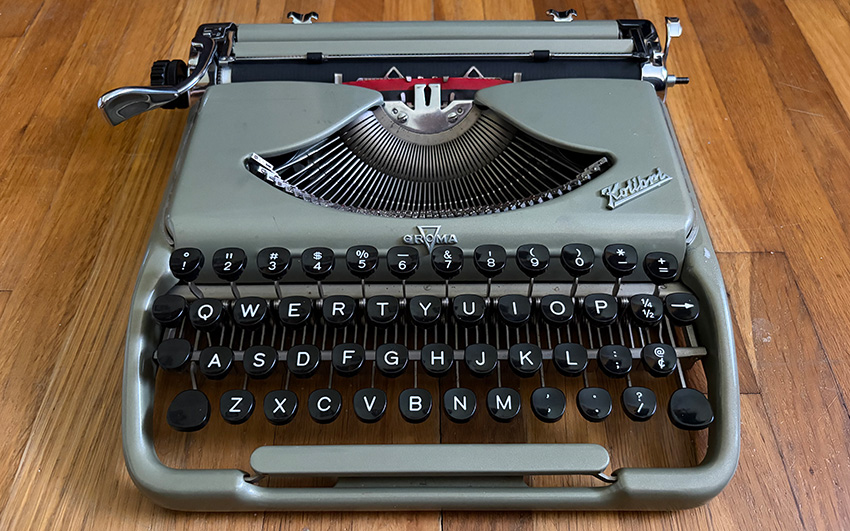
The serial number puts this machine right at the front of its year: 580087, eighty-seven units into a run that started at 580000. Groma made a lot of Kolibris between 1951 and 1962. This one left the factory early in 1956, olive green, black keys, and a real American QWERTY keyboard.
No accents, no odd math symbols, no British pound sign standing in for the dollar. This was not the norm for export Kolibris.
Collectors who deal in these machines regularly note the opposite problem: sourcing one with a clean US keyboard is the hard part, because so few were built that way. Most export units had a European-inflected layout instead, something closer to an international compromise than a true American export.
Machine Record
This one was a long time in the making. The seller lived farther than I wanted to drive for a typewriter, until it turned out he’d be taking his daughter to college later this summer, and the campus sat a lot closer to me than his house did.
So I waited.
Facebook Marketplace doesn’t tell you who you’re dealing with. A seller can go quiet. A seller can sell to someone closer and never mention it. Neither happened here. We kept in touch, and when the timing lined up, we closed the deal.
Aesthetics

The name fits. Kolibri means “hummingbird,” and this is one of the slimmest typewriters ever made, just over ten inches long and under two and a half inches tall. Olive green wasn’t the standard color for a Kolibri leaving Markranstädt in 1956, either.
Still, the right platen knob is missing, and the paint has a few dings. Deducting for both.
8/10 clacks.
Typing Feel
Key tops stay flat through their entire travel path. A stabilizing key comb keeps them from bending sideways, and the stroke lands short, snappy, and responsive.
The sound and feedback you get is surprisingly solid and clunky for its size. Despite a smaller footprint than both the Hermes Rocket and Smith-Corona Skyriter, the Kolibri is a full pound heavier.
8/10 clacks.
Features

As an ultra-portable, the Kolibri is light on features by design. No dedicated [1/!] key, no tab settings, no touch control, no bi-color ribbon selector, no carriage lock, no page guide. The platen’s small diameter limits what paper stock will work, too.
None of that’s a deal-breaker for me. But I’ll miss having tab settings every time I sit down to type.
3/10 clacks.
Portability

It’s small, even by ultra-portable standards. The keys don’t feel cramped, and the size never gets in the way of typing normally.
Instead of a bulky box, the case looks like a zippered folder, or a slim attaché. Easy to forget you’re carrying a typewriter at all.
9/10 clacks.
Historical Significance

Joseph Brodsky, Nobel Prize-winning Russian-American poet and essayist owned one. British novelist, journalist, and political commentator, Will Self, owned several. Though by his own account he eventually got rid of them all and kept only two Olivettis.
The Kolibri had its hold on Georg Dreyman in The Lives of Others, where the East German playwright types his most dangerous pages on one. That’s the connection most people will actually recognize.
7/10 clacks.
Overall
This is the rarest and most expensive typewriter in my collection. Other collectors will clutch their pearls when they hear what I’m about to do with it: I bought this machine planning to tear it apart.
Every collector has a price, a point where the right offer moves an object out of the collection and into someone else’s hands. Not this one. This Kolibri stays. It’s mine, and I’m going to customize it.
7/10 clacks.
Stay tuned for Project: Kolibri.