This case is at the center of one of the most durable conspiracy theories in American history. It played out just as Cold War anti-communist anxiety was tightening its grip on the country. A private investigator who may have been secretly reporting to the FBI. A federal judge who took a forgery theory seriously enough to spend several pages rejecting it. A Nixon quote that still circulates online, half true and half misheard, then corrected decades later.
All of it circles back to one object, a Woodstock typewriter that was possibly forged to frame one of the most respected men in Washington.
The Players
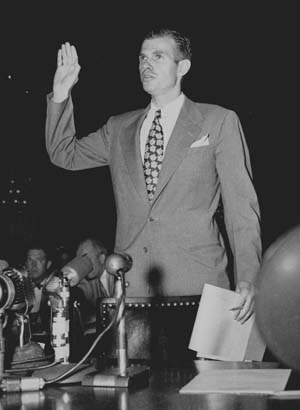
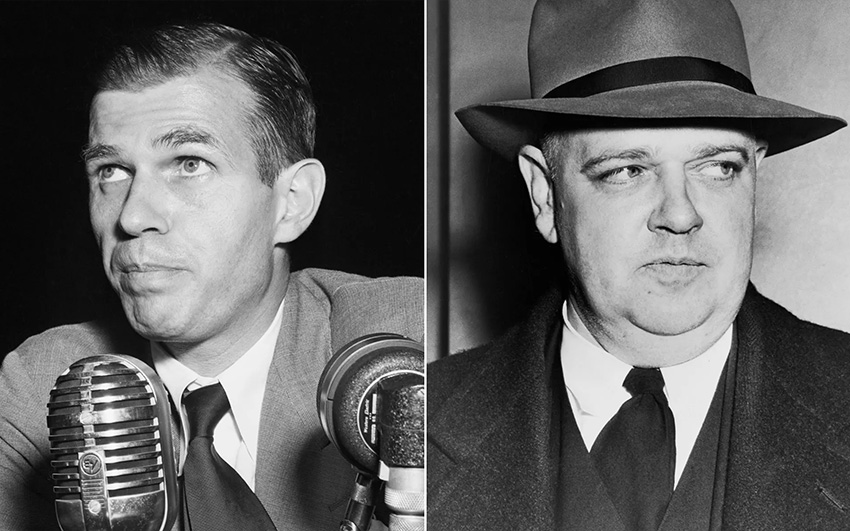
Alger Hiss was forty-four years old when his first perjury trial began in May 1949. He’d been a clerk for Supreme Court Justice Oliver Wendell Holmes, joined the State Department under Cordell Hull in 1936, attended the Yalta Conference as part of the American delegation in February 1945, and served as Secretary-General of the San Francisco conference that founded the United Nations two months later. By 1946 he was president of the Carnegie Endowment for International Peace. This was not an obscure man.
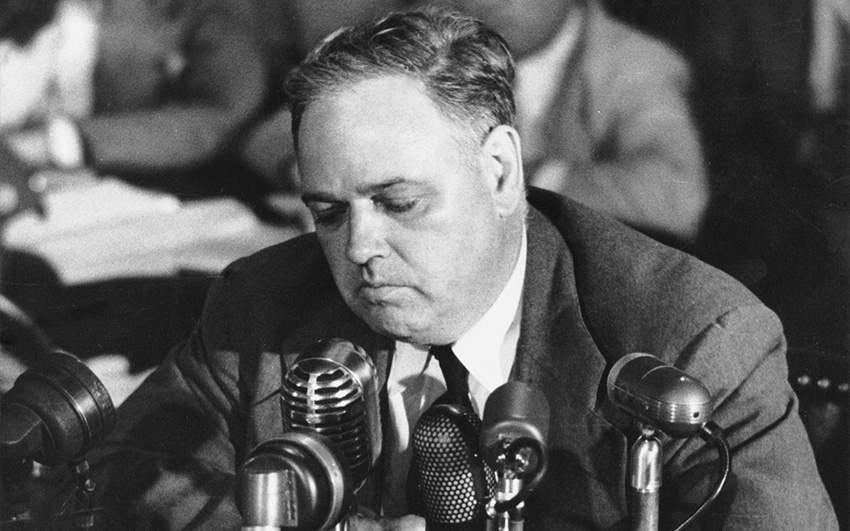
Whittaker Chambers was a senior editor at Time magazine, just a decade removed from his years as an underground courier for the Communist Party. He was a Columbia dropout from a troubled Philadelphia family, about as far from Hiss’s Harvard polish as two men could get.
Priscilla Hiss, Alger’s wife, held a bachelor’s from Bryn Mawr and a master’s in English literature from Yale. She worked as a schoolteacher and book editor, and was a registered Socialist. Her testimony would end up doing more damage to her husband’s case than almost anything else in it.
Richard Nixon was a relatively unknown freshman congressman on the House Un-American Activities Committee (HUAC), a committee most of Washington considered a joke. By the time this case was over, nearly everyone in the country would know his name.
The Communism Angle
By 1948, HUAC had already spent a year hauling Hollywood screenwriters in front of cameras, asking if they were or had ever been Communists, and President Truman had ordered loyalty reviews of federal employees across the entire government. The country was deep in what historians now call the Second Red Scare. Finding a Communist inside the State Department, one who’d helped shape the postwar order at Yalta and in San Francisco, was exactly the kind of story the moment was primed for.
In August that same year, Chambers told HUAC that Hiss had belonged to an underground Communist cell in the 1930s, part of what he called the “Ware Group,” organized by an agriculturalist named Harold Ware. Chambers said its original purpose was infiltration, not espionage, at least at first. Two days later, Hiss testified and denied all of it under oath.
The two men might have stayed locked in a standoff indefinitely if not for a bird. During a later hearing, a committee member asked Hiss what his hobbies were. He mentioned amateur ornithology. Another member followed up: had he ever seen a prothonotary warbler? Hiss, without thinking, said yes, right there on the Potomac in Washington, D.C.
Chambers had described that exact detail to investigators weeks earlier, a level of specificity HUAC members decided a stranger couldn’t have known. It was a small moment, and it’s the reason the committee stopped treating this as an unresolvable he-said-he-said.
Hiss sued Chambers for slander over his public comments. During pretrial questioning for that lawsuit, Hiss’s attorney, William Marbury, asked Chambers to produce any correspondence from the Hiss family. Chambers responded with sixty-five retyped State Department pages and four handwritten notes, pulled from an envelope he said had been sitting in a dumbwaiter shaft in a relative’s house.
The government couldn’t charge Hiss with espionage. The five-year statute of limitations had already run out. What remained was perjury, for denying under oath that he’d ever passed Chambers documents or seen him after January 1, 1937.
Proving that would put a typewriter on trial.
The Evidence
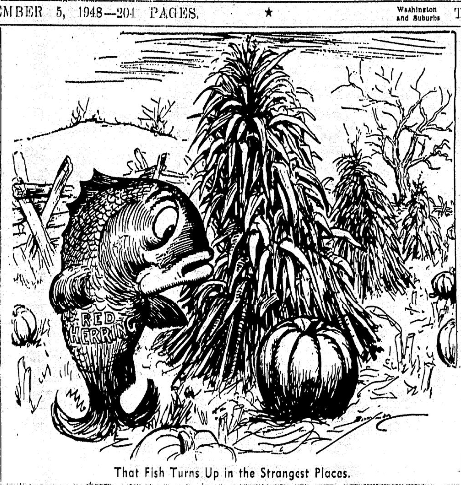
The Baltimore Documents are the sixty-five typed pages and handwritten notes Chambers turned over on November 17, 1948. The Pumpkin Papers are rolls of 35mm film, found two weeks later on December 2, hidden in a hollowed-out pumpkin on Chambers’s Maryland farm. Different find, different date, different physical evidence. Some accounts blend the two together.
FBI document examiner Ramos C. Feehan compared the Baltimore Documents against four separate letters admittedly typed by Priscilla Hiss, known as the Hiss Standards. In a later affidavit, he described examining and comparing typewritten characters, weighing style, alignment, spacing, and defects. When asked to walk the jury through his reasoning, he highlighted a handful of specific examples, the wear on certain letters among them. He was never cross-examined on any of it, at either trial.
The typewriter itself was difficult to trace. Priscilla said the family gave the machine to their housekeeper, Claudie Catlett, for her children, at the end of 1937. From there it passed through several more hands over the next decade. Edward McLean, part of Hiss’s defense team for the first trial, tracked it down and bought it in April 1949, eleven years after Priscilla said she’d given it away, and introduced it into evidence as Exhibit UUU.
One of the Catlett children testified he took the machine to a specific repair shop shortly after the family received it. Prosecutor Thomas Murphy’s cross-examination showed that shop hadn’t opened yet, not for another nine months, a small detail that did real damage to the defense’s own timeline.
Priscilla herself admitted on the stand to typing the four letters that became the Hiss Standards, the admission Feehan’s entire comparison depended on. Her account of when the family gave up the typewriter didn’t hold together either, at one point telling the grand jury it might have gone to the Catlett family as late as 1943, years off from the date the rest of the defense’s own story required.
The Machine
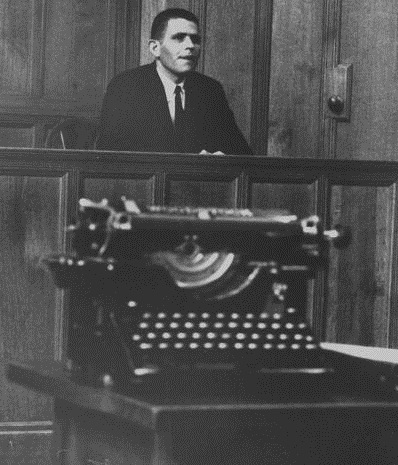
Here’s what that testimony did not do: it never mentioned the recovered Woodstock, the machine the defense introduced as Exhibit UUU. Feehan’s comparison was strictly page to page, the Baltimore Documents against the Hiss Standards. The physical machine sitting in the courtroom was never part of his analysis.
Murphy didn’t make that distinction for the jury, either. In his second-trial closing, gesturing at the machine, he said the Baltimore Documents “were typed on that machine. Our man said it was.”
Only, our man (Feehan) hadn’t actually said that.
Irving Younger, a trial lawyer, made the same point in a 1975 Commentary article arguing, on the whole, that Hiss was guilty. The FBI’s real authentication, Younger wrote, rested on comparing the Baltimore Documents to a separate 1937 document Priscilla Hiss had typed, not on the machine the defense brought into court.
“Nothing would have changed had the Woodstock never been found.”
Coming from a lawyer arguing Hiss’s guilt, that’s a real concession: the physical exhibit was closer to a prop than to actual evidence.
The first trial ended in a hung jury, eight for conviction, four against. All twelve believed the documents came from the Woodstock typewriter the Hiss family once owned. The four holdouts weren’t convinced Alger or Priscilla had typed them.
The Serial Number Problem
According to production figures from both the FBI and the defense, Woodstock had built roughly 177,000 machines by the start of 1928, and roughly 204,500 by the start of 1929.
Harry Martin, the surviving partner of the insurance firm that had first bought the Hiss family’s typewriter, and Thomas Grady, the Woodstock salesman who sold it to them, independently and repeatedly told the FBI the sale happened in 1927. That would put its serial number under 177,000.
Exhibit UUU’s serial number is 230099, squarely a 1929 machine. The FBI’s own Philadelphia field office flagged the gap in writing to Director Hoover:
“The definite possibility exists this typewriter is not the one received by Priscilla Hiss from her father.”
Hoover’s response wasn’t to investigate further. It was an instruction to keep the doubt confidential. The defense never saw it. The jury never heard it. It surfaced only in 1976, when Hiss himself, more than two decades after he’d served his prison time, obtained it through a Freedom of Information Act lawsuit.
Additionally, Murphy obtained a court order between the first and second trials to take fresh typing samples directly from Exhibit UUU. The FBI lab matched those samples to both the Baltimore Documents and the Hiss Standards, the actual link between the physical machine and the case that had never been established in open court.
There’s a further complication: by multiple later accounts, the investigator Hiss’s defense hired to track down the missing typewriter was also in contact with the FBI, the same government working to convict his client.
None of this was disclosed to the defense or mentioned in Feehan’s second-trial testimony. It came out after the fact, in the same 1976 FOIA disclosure.
The Forgery Motion
Before sentencing, Hiss told Judge Henry Goddard he expected “the full facts of how Whittaker Chambers was able to carry out forgery by typewriter” to eventually come out. In January 1952, two years after sentencing, Hiss’s post-conviction attorney Chester T. Lane tried to make good on that, filing a motion for a new trial that called Exhibit UUU:
“A deliberately fabricated job…planted on the defense by or on behalf of Whittaker Chambers.”
The defense hired Martin Tytell, a typewriter engineer, to test whether a duplicate convincing enough to fool an examiner could even be built. Tytell spent roughly a year on it, working only from typed samples, without ever touching the original machine. A document examiner working for the defense, comparing Tytell’s replica against Exhibit UUU under a microscope, still found consistent points of difference between the two.
Another defense expert put it more bluntly in her own sworn statement: setting the typewriter forgery question aside entirely, ordinary document-examination standards would have led her to conclude all three sets of documents, the Baltimore Documents, the Hiss Standards, and fresh samples from Exhibit UUU, came from the same machine.
A separate defense witness, a chemist, examined Exhibit UUU’s typefaces directly and reported something that sounds, on its face, like real physical evidence: solder left unfiled on 29 of the machine’s 42 keys, and higher nickel content than on comparison machines, signs, he argued, of deliberate alteration rather than ordinary wear. Three former Woodstock plant employees, including two former plant superintendents, disputed this for the government, saying the solder pattern was unremarkable and consistent with normal factory and repair work.
Judge Goddard denied the forgery motion in July 1952. He noted that if Chambers really had built a duplicate machine, he’d have had to do it in about three months, working only from typed samples, faster than the defense’s own hired experts managed with more time and more resources, and their result still, in Goddard’s words, “falls short of being a perfect duplication.”
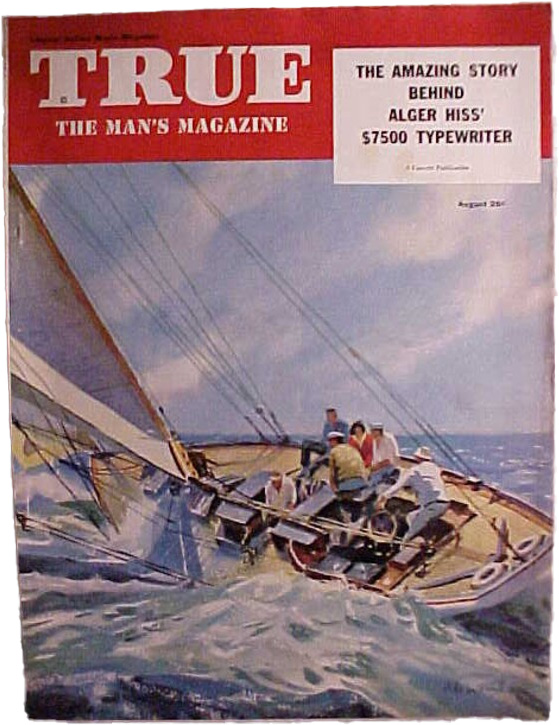
He also found no evidence Chambers had the mechanical skill for the job, or any plausible way to know where a counterfeit, planted machine would actually be found by the defense team. A month later, True Magazine ran a ghostwritten piece crediting Tytell that told a different story, implying he’d essentially pulled it off. The court record and the magazine story don’t agree on how the experiment actually went.
One more piece of this surfaced even later. In 1976, Hiss called former FBI official, William Sullivan, directly and asked whether the typewriter had been fabricated inside the FBI’s own lab. Sullivan, recounting the call in a memoir three years afterward, said he told Hiss no, and that the Bureau wouldn’t have had the technical capability to pull it off even if it had wanted to.
The Unresolved
Nobody ever demonstrated Exhibit UUU was a forgery. Tytell tried, with real skill and a full year of work, and a document examiner working for the defense could still tell his machine’s output apart from the original. What’s actually documented is narrower, and worse in a way: the government had internal doubts about its own key exhibit and chose to keep them quiet, and the prosecutor told a jury more than his own expert had testified to.
There’s a separate question this post won’t try to answer: whether Hiss was, in fact, a Soviet agent. That rests on different evidence entirely, decrypted Soviet cables released in the 1990s under the VENONA program, which most historians who’ve studied them believe identify Hiss by a wartime cover name.
One more thing worth sorting out. John Dean’s 1976 memoir claims Nixon once told an aide, “We built one” in the Hiss case, a line Dean read as an admission of fabricated evidence. The aide denied recalling it. Nixon called it “totally false.” It’s never been confirmed either way.
Separately, on an actual February 1973 recording of Nixon talking with Dean about the case, an early White House-prepared transcript rendered one line as “we got the typewriter,” exactly the kind of confirmation that rumor would need. A different transcript, the one used in a 1997 book on the tapes, has Nixon saying “we got the Piper,” most likely a reference to Marbury, the same attorney whose deposition produced the Baltimore Documents in the first place, whose firm was called Piper.
The rumor is real. The one piece of it that was caught on tape was supposedly a mishearing and re-transcribed to correct the official record.
The Aftermath
Hiss was convicted on two counts of perjury on January 21, 1950, and sentenced to five years on each count, to run concurrently. He served three years and eight months in Lewisburg Federal Prison, and was released in November 1954. Hiss spent the remaining years of his life maintaining his innocence, including two books (1957 and 1988), until his death in November 1996.
After the trials, Chambers retired to his farm near Westminster, Maryland, and in 1952 published his autobiography, Witness, covering his time in the Communist underground, his break with the Party, and the Hiss case. The book became a major influence on postwar American conservative and anti-communist thought, later cited by Ronald Reagan as central to his own political shift from New Deal Democrat to conservative Republican. Chambers died of a heart attack on July 9, 1961, near his farm, at age 60. In 1984, Reagan posthumously awarded him the Presidential Medal of Freedom.
Joseph McCarthy gave a speech, claiming to have a list of Communists inside the State Department, on February 9, 1950. Historians treat that proximity as more than coincidence. Hiss’s conviction had just made the idea of communists holding positions of authority inside the federal government look credible to people who’d doubted it, and McCarthy walked directly through the open door it left.
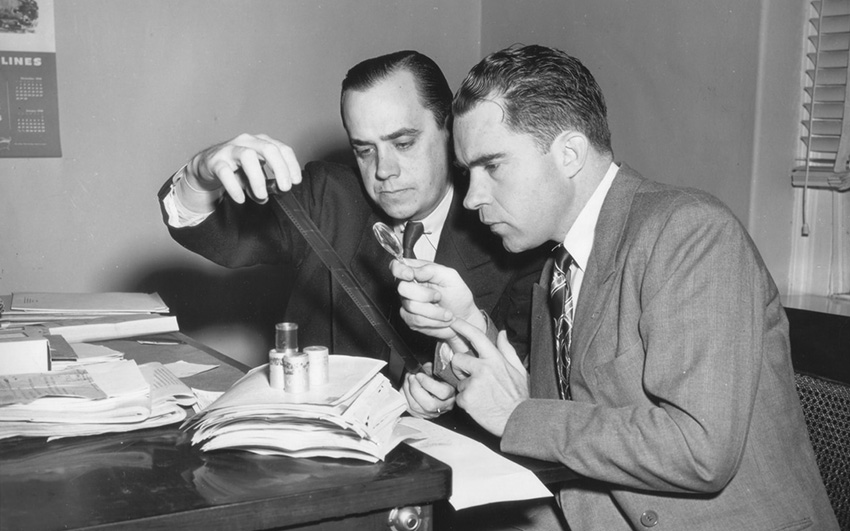
Nixon’s career benefited from this case even more directly. Publicity from chairing the subcommittee that pursued Hiss carried an obscure freshman congressman to the Senate in 1950, the vice-presidency in 1952, and the presidency in 1968. He never stopped returning to it as a template. On a White House tape recording from July 1971, discussing how to handle the Pentagon Papers leak, Nixon told an aide:
“We won the Hiss case in the papers. We did. I had to leak stuff all over the place…It was won in the papers. I leaked out the papers.”
Hoover headed the FBI for twenty-four years before Hiss-Chambers, and would keep running it until his death in 1972. What this case demonstrated, and arguably emboldened, was how quietly Bureau information could move to a political ally when it suited him, the same institutional habit already on display in his instruction to keep the serial-number doubt confidential rather than resolve it in the open.
Three of the defining political careers of the mid-twentieth century ran, in some part, through this one machine. Not one of the men it helped along was straight with the public about what he actually knew.