Cheri Jo Bates was murdered near a community college campus in Riverside, California, and for the sixty years since, her case has sat at the edge of the Zodiac story without ever officially joining it. Zodiac himself would later claim her. Riverside police still say he’s wrong.
Whichever of them is right, the typed letter mailed a month after the murder is the same category of evidence as the first two posts in this series: a specific machine, a specific typeface, exactly what document examiners had been comparing since Levy v. Rust in 1893. Except here there’s no ruling to quote and no testimony to walk through, because the comparison that should have settled the question, twenty-five years later, on a matching machine sitting in a suspect’s own home, appears never to have been run at all.
The Letter
Cheri Jo Bates was eighteen when she was killed on the grounds of Riverside City College on October 30, 1966. Someone had disabled the ignition wiring and distributor on her 1960 Volkswagen Beetle, stranding her in the dark, then attacked her with a knife. Multiple stab wounds to the chest and shoulder. Three slash wounds across the throat, deep enough to sever the jugular and the larynx. She’d been kicked in the head. She wasn’t robbed. She wasn’t sexually assaulted. Whoever did this wanted exactly one thing, and it was the killing itself.
The evidence recovered at the scene reads like an inventory of near-misses. A Timex wristwatch, paint-spattered, the strap torn. A partial footprint matching military-surplus boots, size 8 to 10, sold only through base exchanges. Skin and hair under the victim’s fingernails. Smeared palm prints and fingerprints on the Volkswagen Beetle that never matched Bates or her inner circle. Every one of these could have named a killer. None of them ever did.
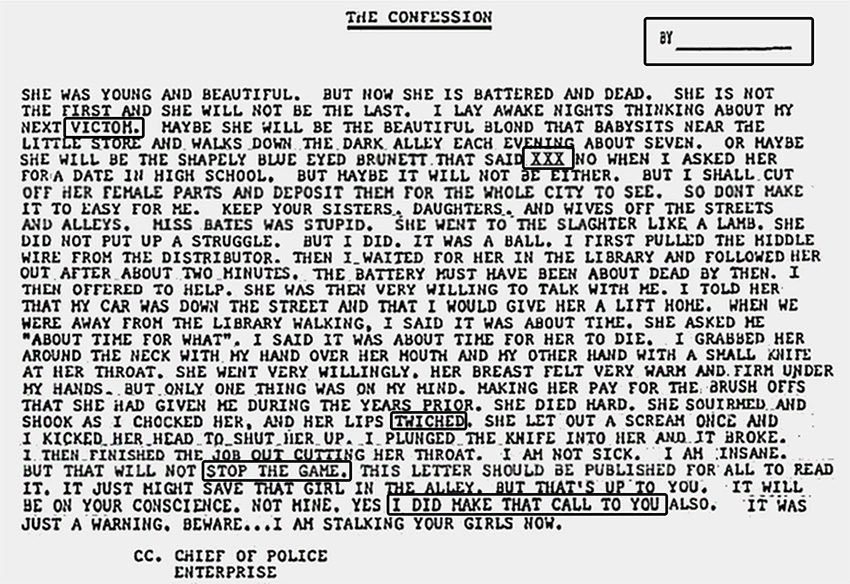
Thirty days later, on November 29, 1966, two nearly identical letters arrived by mail. One went to the Riverside Police Department. One went to the Riverside Press-Enterprise. Both were typed, describing the murder from the killer’s point of view, down to watching Bates try the ignition and offering to help before he led her away. “Making her pay for the brush-offs that she had given me during the years prior,” the letter reads.
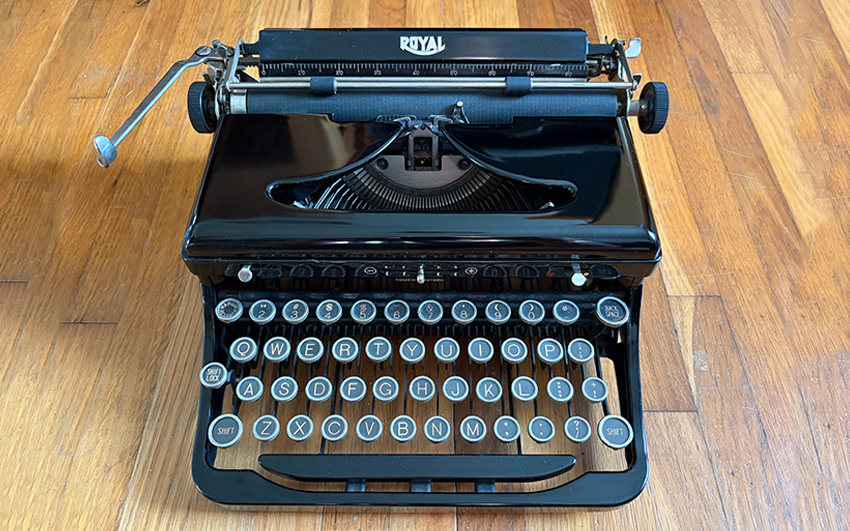
Investigators identified the machine as a portable Royal. A specific, ordinary, mass-produced object, the same category of machine that hung Judge Pitney’s ruling in 1893 and put Alger Hiss in Lewisburg fifty-seven years later.
That’s where the comparison to the first two posts in this series ends. Neither of those posts had to guess at the typewriter’s fate.
This one does.
The Machine
Twenty-five years passed. On February 13, 1991, Vallejo Police detectives executed a search warrant at the Fresno Street residence of Arthur Leigh Allen, by then the Zodiac case’s prime suspect. They found ammunition consistent with the Lake Herman Road murders, the crime that opened the Zodiac case in December 1968. A knife similar to the one used at Lake Berryessa in September 1969. And an old Royal typewriter. All belonging to a man they’d already spent years investigating.
According to an account of the FBI’s own 1992 case memo, the language is direct:
“An older Royal typewriter with elite type was found during the service of the search warrant at Allen’s residence on 02/91.”
The same source states, just as directly, that the machine was never run against the Confession Letter:
“To date, even though it was an item it was looking for in the 1991 search, [Vallejo PD] has not attempted matching Allen’s typewriter to that of the anonymous confessions.”
Investigators had gone looking for that specific object. They found it. The comparison that would have told them something, one way or the other, doesn’t appear to have happened.
I keep turning that over. Not because it proves anything about Allen. It doesn’t. This is the opposite story from the other two posts in this series, where the whole point was that someone sat down and made the comparison, wrote it up, put a number on it. Here the one object that could answer the question just sits in an evidence log, twenty-five years cold before it was even found, and thirty-five years colder now.
What Came Back Negative
Allen was never charged. He died of a heart attack on August 26, 1992, still under suspicion. Shortly before his death, he’d written to a reporter who’d just interviewed him, denying he was the Zodiac, a letter later noted for grammatical mistakes echoing the ones in Zodiac’s own correspondence.
Other evidence against him didn’t hold up. His handwriting samples, taken by San Francisco police in 1972, weren’t a definitive match. A DOJ document examiner said the handwriting shouldn’t be used to eliminate him either way, which settles nothing in either direction. Retired examiner Lloyd Cunningham was blunter about it in 2009: “None of his writing even came close to the Zodiac.” Fingerprints lifted in 1991 didn’t match the one confirmed print from Paul Stine’s cab. A partial DNA profile pulled from Zodiac’s letters in 2002 excluded Allen entirely.
None of that touches the typewriter. It’s tempting to read “ruled out” across the whole case file and assume the machine was part of what cleared him, but that’s not what the record shows. The handwriting was tested and came back negative. The fingerprints were tested and came back negative. The 2002 DNA panel was tested and came back negative. Three separate forensic disciplines, three separate exclusions.
What’s worth noting is that the typewriter, the one piece of physical evidence built for exactly this comparison, was never entered into that list at all.
A Different Letter, and a Different Answer
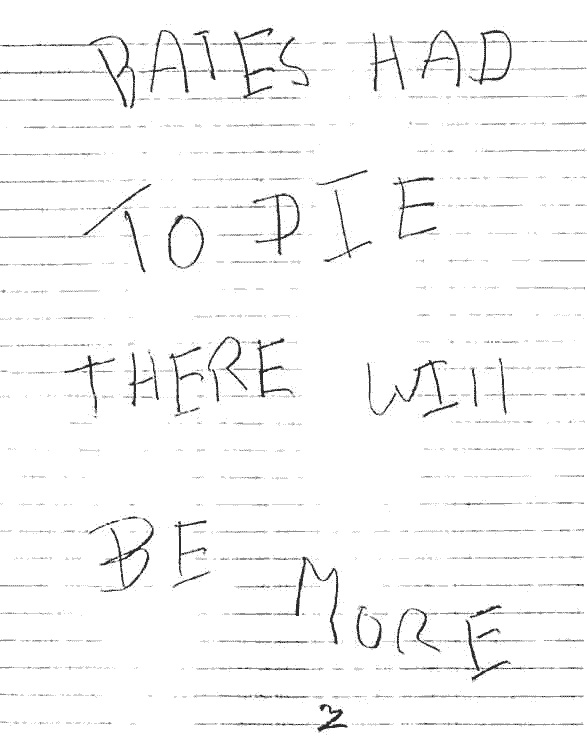
There’s a second piece of correspondence in this case, and it needs to stay separate from the first. Six months after the Confession Letter, between April 30 and May 1, 1967, three more letters went out, this time handwritten, this time reading “Bates had to die. There will be more,” with an ambiguous mark at the bottom that could be a “2” or a “Z.” One went to police. One went to the press. One went to Bates’s own father. The envelopes carried more postage than a letter that size needed, the same habit later Zodiac letters would repeat.
A library desk at Riverside City College turned up something related around the same time: a poem scratched into the wood, “Sick of living/unwilling to die,” graphic and violent, signed with the lowercase initials “r h.” Handwriting examiner Sherwood Morrill looked at the desk carving and the 1967 letters together and, in November 1970, told a reporter they were “unquestionably” written by the same person who later wrote as Zodiac. Not everyone agreed. In 1978, the Director of the Postal Crime Laboratory reportedly concluded the opposite, that Zodiac hadn’t written any of it.
Here’s the part that actually got resolved. In September 2021, Riverside PD’s Cold Case Unit and the FBI’s Los Angeles genealogy team announced that DNA lifted from a postage stamp had identified who wrote those three handwritten letters. A man from San Bernardino had come forward anonymously in 2016, admitting he’d written them as a teenager looking for attention, calling it a “distasteful hoax,” and denying he was Zodiac or Bates’s killer.
Investigators sat on that confession for four years before they ran the stamp DNA in 2020. The answer, when it finally came, was almost anticlimactic: a hoax by a teenager with no connection to the murder or to Zodiac, resolved fifty-five years after the fact by a piece of forensic technology that didn’t exist when the letter was licked shut.
But read that again. It’s the handwritten letters that got answered, not the typed one. The Confession Letter, the letter this whole series is actually built to write about, is still sitting exactly where it was in 1966.
The Unresolved
Riverside Police have said, as recently as 2021, that there is no evidence connecting Bates’s murder to the later Zodiac killings, and that they believe her killer came from Riverside County itself. Zodiac claimed otherwise. In a March 13, 1971 letter to the Los Angeles Times, he wrote that police deserved credit for “stumbling across my Riverside activity,” then added that they were “only finding the easy ones.”
Read one way, that’s a killer taking ownership of a crime he actually committed. Read another way, it’s a man who liked being blamed for things, adding one more unsolved murder to his own legend at no cost to himself. Zodiac was never shy about taking credit. He also, more than once, took credit for things he almost certainly hadn’t done.
A document examiner could have narrowed that question to something closer to a fact instead of a reading. Three defects, the way Pitney’s mechanic found three in 1893. A serial number, the way Feehan traced one on the Woodstock. Instead there’s a Royal typewriter that surfaced once, in a house on Fresno Street, in front of investigators who had a specific reason to want the answer, and then, on the available record, nothing.
Detective Jim Simons told the Press-Enterprise in 2016 that Riverside PD had one person of interest they strongly believed committed the murder, but not enough physical evidence to make an arrest. That’s where it still sits. Not unsolved for lack of a name. Unsolved for lack of the one piece of evidence that could have connected that name to the letter, and, on the record, never was.
The Royal itself may still exist in an evidence room somewhere. It may not. I don’t know, and neither, as far as I can tell, does anyone who’s written about this case in the years since.
The pattern didn’t end with Allen’s death. This Is the Zodiac Speaking, the 2024 Netflix documentary that reopened the Allen theory for a new audience, introduced a knife tested for blood and then never disclosed the DNA results on screen.
It surfaced letters read as a near-confession and barely examined what they actually said. One review called the show out for exactly this: it “introduced these two massive pieces of evidence but completely failed to actually examine them.” Thirty-three years after the Fresno Street search, the case is still doing this.
Evidence surfaces. The follow-through doesn’t.