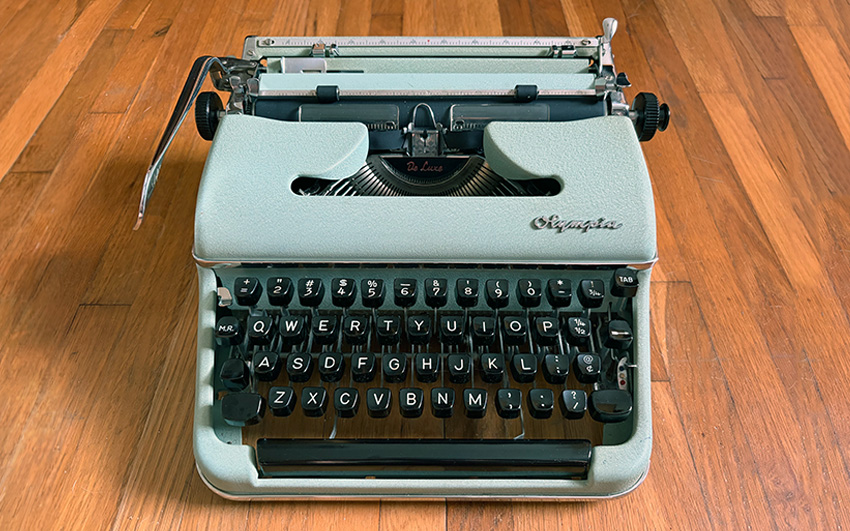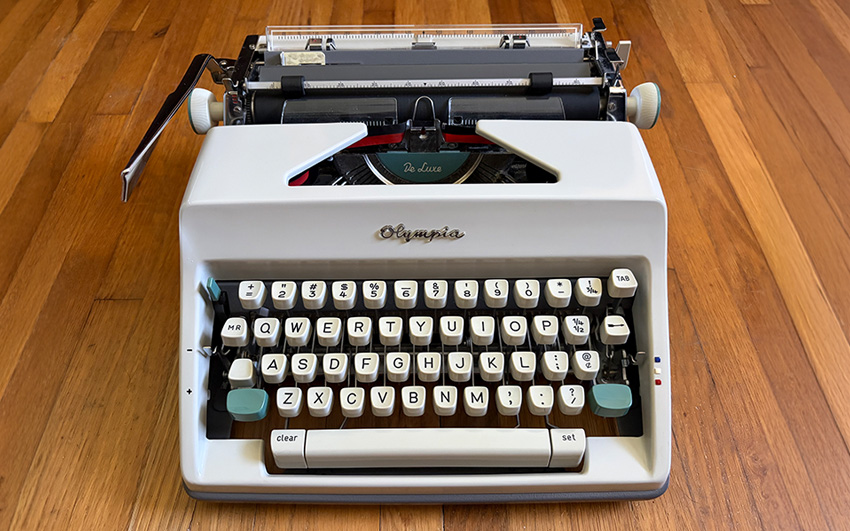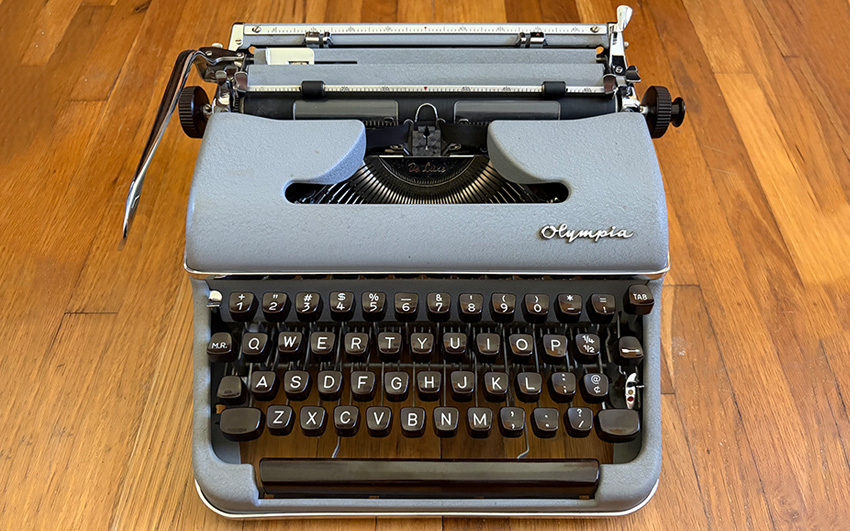
If American manufacturers were racing toward color and styling in the late 1950s, Olympia of West Germany was after something else entirely: precision. The SM3 is widely regarded by collectors and users alike as one of the finest mechanical writing machines ever built.
Engineering Over Everything
Olympia built its postwar reputation on fit and finish. The touch is precise and sturdy, which made it one of the pricier portables on the market and one built to survive decades of daily use.
It came with adjustable line spacing, single, one-and-a-half, double, and six repositionable tab settings for clean columnar work. Plexiglass alignment guides had notches cut into them for slotting in a pencil, so a typist could hand-guide the carriage and draw a straight line or a box without a ruler.
Rounded, Modern, and Built to Order
Styling moved away from the boxier, squared-off look of prewar and early-1950s portables toward something rounder and more modern, distinctly midcentury without following the pastel trend running across the Atlantic.
Machines shipped in a range of crinkle and glossy paint finishes with matching cases, and a buyer chose the typeface at purchase: Pica, Elite, Italic, and rarer options like Congress and Double Gothic Pica that still turn up on surviving machines. That’s part of what collectors are chasing now, not just the machine, the specific typeface it left the factory wearing.
A Transitional Year
The SM3 had been in production since 1951 and would run until 1961. 1958 was also the year Olympia introduced the SM4, which added a keyset tabulator (tab keys on either side of the spacebar). The two models ran side by side after that, and that overlap is exactly what trips up a new collector trying to identify a machine by serial number alone. Most manufacturers retire one model before the next one ships.
Machine Record
Another Marketplace find. The listing was 3 for $100: this Olympia SM3, a black 60’s era QDL, and a Remington Model 5 that had seen better days. I didn’t really want the Remington or QDL, so we settled on $50 for the Olympia by itself.
Aesthetics

Olympia launched the SM3 in 1951 out of its West German factory and sold it as the top of the line: “the finest writing machine money can buy… it’s built better, for life.” People still call it the Mercedes-Benz of typewriters. The polished metal finish runs through the whole machine, in places most manufacturers wouldn’t have bothered matching.
My model also has italic typeface. Maybe not as desirable as script, but more uncommon.
9/10 clacks.
Typing Feel
The reputation is earned. Every keystroke has the same short, precise arc from fingertip to page, no slack in the mechanism, no wasted travel. It’s the closest thing to a machine that already knows where the letter needs to land before you do.
I’ll risk sounding pretentious and say it plays more like a mechanized symphony than a writing tool, every part built for one job and all of them in sync.
9/10 clacks.
Features

Compared to most 1950s portables, which were competent but utilitarian, the SM3 is a sort of engineer’s typewriter: tunable touch, no-compromise tolerances, and finish quality that punched above its class, which is exactly why it built the cult following it has. A keyset tabulator didn’t come along until the SM4 model, the one thing it’s missing.
8/10 clacks.
Portability

It has a smaller footprint than a lot of other portables, but still very heavy. The SM3 is generally distinguishable from its siblings just by case shape: it usually came with a futuristic-looking, curvy silver case with a plastic strap handle, while the SM2 and SM4 came in rectangular cases.
4/10 clacks.
Historical Significance
The SM3’s user list reads like a syllabus. John Updike, Woody Allen, Frank Herbert, Patricia Highsmith, Robert Penn Warren, John Hughes, and Louis L’Amour (just to name a few). The SM3 has an unusually deep bench for a single typewriter model.
Because the SM3 was a premium machine that commanded a premium price, most surviving examples are in pretty good shape. Owners who could afford one tended to take care of them.
9/10 clacks.
Overall
The math says 8. I’m giving it a 9. Beautiful design, real fit and finish, a typing feel I still can’t fully describe with the right words. You have to sit down at one to understand it. The SM3’s reputation says this is one of the best typewriters ever made. I don’t have a reason to argue.
9/10 clacks.