When most typewriter makers were stripping their machines down to bare bones to survive the Great Depression, Remington went the other direction with the Model 5. It was a full-featured portable meant to look sharp, type smoothly, and hold up for decades.
A Machine Interrupted by War
The Model 5 hit its stride just before the war. Production peaked around 1941, roughly 2,500 units a month. Then Remington’s factories converted entirely to war work and became the country’s top producer of M1911 pistols. Typewriter manufacturing all but stopped until the war ended. A 1946 Model 5 is Remington picking the design back up right where it left off, with only small changes from the prewar Streamliner.
Remington Durability
What made the Model 5 stand out wasn’t flash. It was the steel body and smooth action. That earned it a reputation as one of the most dependable portables of its era, a machine a writer could rely on daily without fighting mechanical quirks.
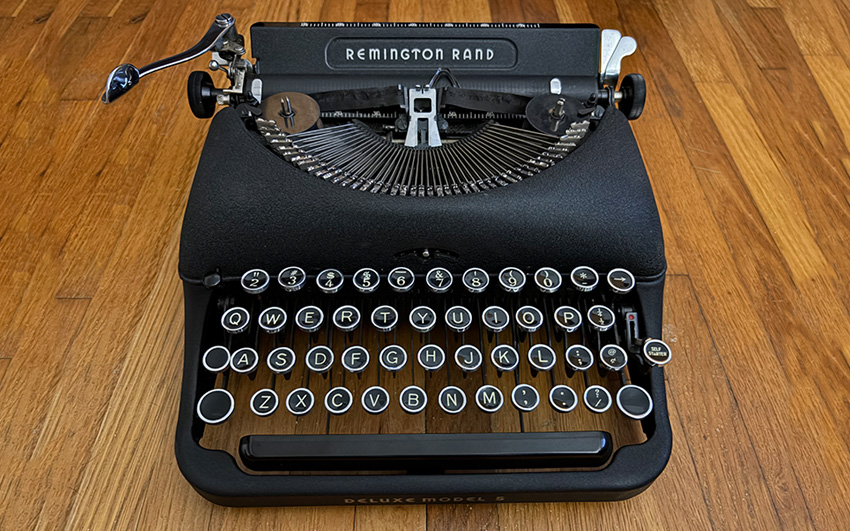
It introduced a small convenience too: a paragraph key that advanced the carriage five spaces on its own, sometimes labeled the “Self Starter.” It usually shipped in black crinkle finish with gold lettered keys, in a leather-wrapped case with a Bakelite handle.
A Design That Aged Well
The Model 5’s rounded, modernist shape has held up remarkably well compared to some of its boxier contemporaries, which is part of why it remains popular among collectors today. It wasn’t chasing trends the way later machines would. It was well-proportioned and built with intention, qualities that are timeless rather than dated.
Machine Record
Another Marketplace find. The seller said they were cleaning out their parents’ attic and found this one tucked in a corner.
The platen has almost no imprints and barely any ink residue, which is unusual even on a platen that’s been recently cleaned. The paint typically shows wear near the keys, or the finish starts to rub off the carriage return handle. Neither is true here.
I’m certainly no expert, but I don’t think this machine saw much use. Eighty years old, and it’s close to pristine.
Aesthetics

Black is the most common color by a wide margin, but this is my first black typewriter, and the color suits the machine: curvy Art Deco lines, chrome-trimmed round glass keys with a black background and gold letters, a wide basket with type slugs that sit flush against the top instead of recessed the way most of my other typewriters have them. Classic. Refined.
8/10 clacks.
Typing Feel
This one surprised me. I’m learning every machine has its own rhythm. Older machines usually ask for more force and a longer keystroke, but this one is responsive and snappy. It’s three years older than my QDL and easier to type on by a wide margin, closer in feel to my SM3.
8/10 clacks.
Features

A premium model in its day, and still light on features next to what came later. No dedicated [1/!] key, no adjustable tab settings, none of the conveniences that show up on machines from the mid-1950s onward.
6/10 clacks.
Portability

Smaller than I expected, especially next to my Tower President XII. It has the heft of a portable but the footprint of something closer to ultra-portable, the smallest machine I own right now. The case is basic but does its job. Easier to carry than most of what’s in my collection.
7/10 clacks.
Historical Significance

1946 was one of the first full production years after Remington reconverted from wartime manufacturing. This typewriter was built at Remington’s Ilion, New York plant, the same site that had made Remington firearms since 1816. No marquee owner is documented for the standard Model 5 itself, but it sat one rung down from the Noiseless Portable that author Flannery O’Connor used.
5/10 clacks.
Overall
This is a staple for a reason: inexpensive, easy to find, distinct enough to be worth owning, which is probably why it turns up in a lot of collections instead of sitting forgotten in an attic like this one nearly did.
It looks good. It types well. It doesn’t have the conveniences of a newer machine, but it’s still a workhorse.
7/10 clacks.