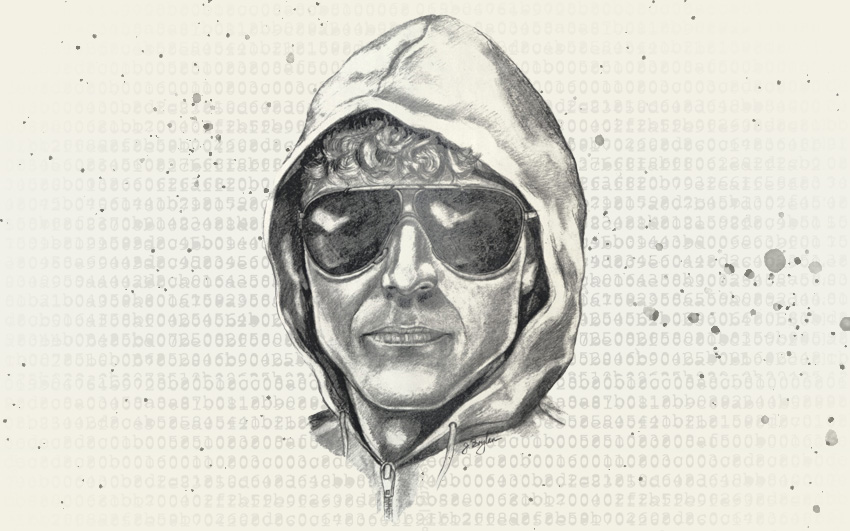
The manhunt started on May 25, 1978, when a package exploded at the University of Illinois at Chicago and injured a security guard. The FBI code-named the case UNABOM, short for University and Airline Bombing, after the two kinds of targets the early attacks kept returning to, before Ted Kaczynski’s list of victims widened well past both.
By the time the case ended, the task force built around that name had grown to more than 150 full-time investigators pulled from the FBI, the ATF, and the US Postal Inspection Service, one of the longest-running manhunts in American history.
Sixteen bombs over seventeen years, three people dead, twenty-three more injured, and a thirty-five-thousand-word manifesto that a killer forced two newspapers to publish before he’d agree to stop.
Kaczynski’s case is one where a typewriter finally got an actual comparison, run against an actual suspect’s actual machine, with an actual result.
What the Bureau Already Knew
Long before anyone had a name to attach to the bombings, FBI document examiners had tied a string of anonymous mail to a single machine. The manifesto. Letters sent to the New York Times in 1993 and again in 1995. A typed label recovered from one of the bomb packages. A note gloating to one of the injured victims.
Different years, different targets, same typewriter. That’s the actual identification work this series has been tracking since Levy v. Rust: not finding a name, just proving that one object produced everything with total confidence, so that whatever suspect eventually surfaced could be checked against it.
Kaczynski helped that effort along, in his own way. Starting in 1993, some of his letters carried a nine-digit number formatted like a Social Security number, printed the same way every time. He wanted newspapers and investigators to know a given letter was really his, not a copycat’s. It’s a strange collaboration, a bomber authenticating his own mail so the FBI could be sure which threats to take seriously. It has nothing to do with the typewriter directly, but it’s the same impulse running underneath both: this correspondence is provably one thing, made by one source, and here’s how you’ll know.
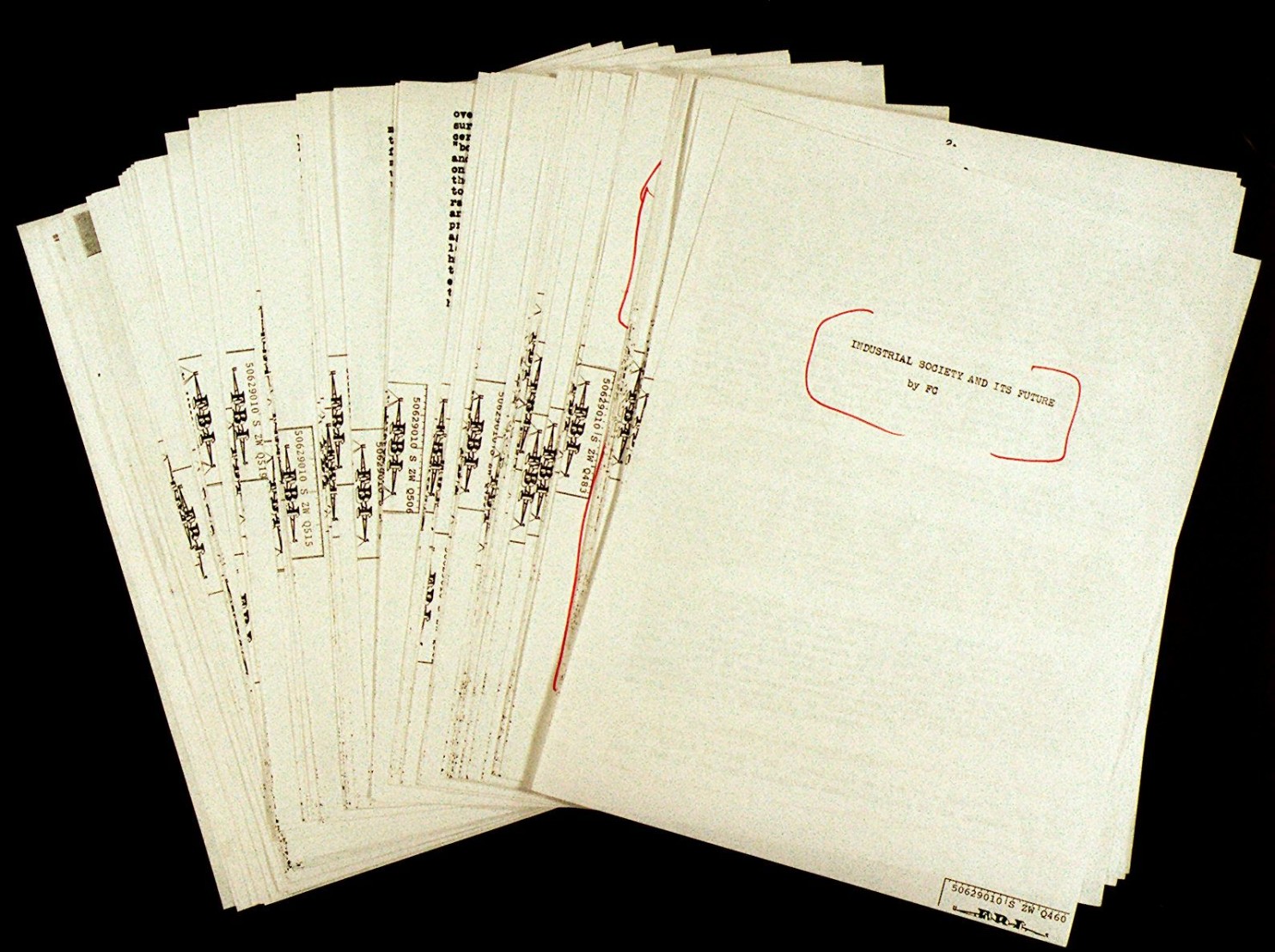
The manifesto itself, Industrial Society and Its Future, reached print because of a threat. In June 1995, Kaczynski demanded one of two newspapers publish it in full, in exchange for a promise to stop the bombing campaign, and threatened to send another bomb if neither paper printed it by Sunday, September 24.
Attorney General Janet Reno and FBI Director Louis Freeh recommended publication on public-safety grounds. The Washington Post ran the full thirty-five-thousand-word document as a special section on September 19, 1995, jointly with the New York Times. It was a bet that someone reading it would recognize the voice. The bet paid off, though not in the way the typewriter thread of this story is about to suggest.
The Cabin
Agents searched Kaczynski’s cabin near Lincoln, Montana, on April 3, 1996. The cabin itself measured ten feet by twelve, no electricity, no running water. Whatever else it was, it was small enough that nothing inside it could have been far from anything else. The search warrant is almost comically plain about what agents were after: item #220 just reads “Typewriters,” no further description, no model, no reasoning given for why one should be there. They found three.
Two didn’t match the documents. Contemporary reporting is specific about that part, the typefaces on those machines simply weren’t the ones examiners had already isolated from years of mail. The third did. It turned up in the cabin’s cramped loft, and beside it was something that made the match almost redundant before the lab even finished: an original typed copy of the manifesto itself, Industrial Society and Its Future, sitting next to the machine that had produced it.
The US Marshals Service, which took custody of the machine after Kaczynski’s conviction, later described it in a 2011 auction listing as the L3 Smith-Corona portable manual typewriter. I couldn’t independently confirm what “L3” designates in Smith-Corona’s own model lineup, as there is no factory model with that name.
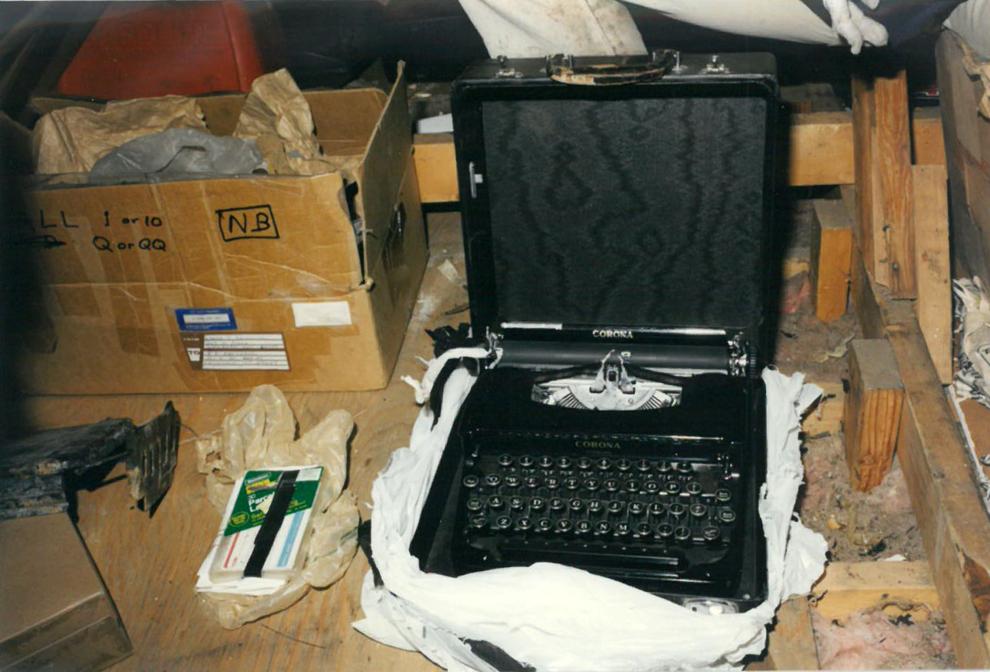
What the surviving photographs do show, though, is a badge reading “L.C. Smith & Corona Typewriters, Inc.,” a company name that only existed from the 1926 merger through the mid-1940s. By the time it was typing threats in the 1990s, the machine was already decades old, a portable from another era entirely. One search photo shows it exactly as agents found it: sitting open in its own case in the loft, wrapped in plastic and cloth, a cardboard box marked in Kaczynski’s own handwriting close by.
How the Match Was Made
One detailed account of the investigation describes the actual comparison as close to hands-on as forensic work gets: agents retyped the Unabomber’s own letters on Kaczynski’s seized machines and studied the results next to the originals under a microscope, character by character, rather than relying purely on a photographic overlay of wear patterns.
The underlying logic was the same one that ran through other posts in this series. A typewriter wears the way anything mechanical wears: a key that strikes slightly high, a letter with a small nick or spur from years of use, spacing that drifts a fraction of a millimeter off true.
Pitney’s mechanic named three such defects in 1893. Feehan traced a Woodstock through a disputed serial number in 1952. Here, decades later, the same category of flaw, misaligned characters, uneven strike depth, a damaged letter repeating itself across years of unrelated mail, is what let examiners say with confidence that one specific machine produced everything from the earliest newspaper letters to the label on a package built to kill someone.
The FBI’s early public statements in April 1996 were still careful to call the match tentative, pending full laboratory analysis. That caution held for exactly as long as it needed to. Kaczynski was arrested that same day, and the government never had to walk this evidence through a jury. He pleaded guilty in January 1998 to avoid the death penalty, and the typewriter never saw a courtroom. The difference is that here, everything else about the machine was actually finished.
The letters, manifesto, and the machine used to create them, all sit fully resolved in the case file.
What Actually Caught Him
The typewriter didn’t catch Ted Kaczynski. It confirmed him, after the fact, once agents already knew who to look for.
What actually broke the case was language, not machinery. Linda Patrik, Kaczynski’s sister-in-law, read the published manifesto first and told her husband David he needed to read it too. David recognized the phrasing, turns of thought he’d heard from his brother for years, and the couple brought old family letters to the FBI so linguists could compare them directly against the manifesto’s prose.
That comparison, not a matched typeface, is what produced Kaczynski’s name as a suspect in the first place. The search warrant, the cabin, the three typewriters and the one that matched, all of it followed from a sister-in-law and a brother reading a stranger’s manifesto and recognizing someone they knew.
What does that mean for the machine at the center of this post? There’s no real reason to think the typewriter comparison would have found Kaczynski on its own. There’s no database of every portable Smith-Corona in Montana to search against a manifesto’s type. You need a suspect’s actual machine in your hands before you can compare anything to it, and the Bureau only had Kaczynski’s cabin to search once his brother David’s tip pointed them there. The typewriter closed a loop that language had already mostly closed. That’s a smaller claim than “the machine caught the Unabomber.”
After
Kaczynski was sentenced in January 1998 to four consecutive life terms plus thirty years, without possibility of parole, at ADX Florence, the federal supermax in Colorado. He stayed there until his death in June 2023. The government held onto his belongings for over a decade before the US Marshals Service auctioned them off in 2011, as part of roughly fifteen million dollars in court-ordered restitution to his surviving victims and victims’ families.
The Smith-Corona sold at auction for $22,003. Two of his other typewriters were in the same sale, bid up to $3,600 before the National Museum of Crime and Punishment, one of the competing bidders, dropped out rather than go higher.
The infamous machine that spent years producing anonymous threats ended up in the hands of a private collector. Someone out there owns it now. I don’t know what they do with it, or whether they think about the loft in Lincoln, Montana, where it was found sitting beside the original document it’s most famous for typing.
The government paid David and Linda a million dollars for the tip that caught Ted. Federal income tax took a big chunk of it, after a bill to exempt the reward from taxes died in Congress. What was left, $630,000, became the Unabomb Survivors Fund, which David set up himself and used to pay out to the people his brother’s letters and packages had reached.