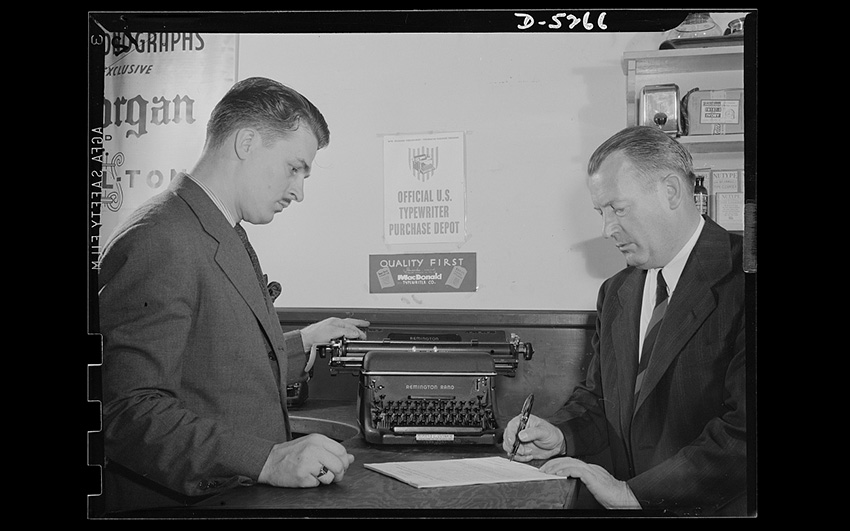
In July of 1942, John K. Stockham walked into a shop in Washington, D.C. and handed his typewriter across the counter to a man named Don MacDonald. MacDonald took it and paid him the fixed government rate.
Albert Freeman, an Office of War Information photographer, was there to record it. The caption on file at the Library of Congress calls it one of the first typewriters enlisted in the war effort.
The Freeze
Four months earlier, on March 6, 1942, the War Production Board had frozen the sale and delivery of every typewriter in America. Civilian manufacturing didn’t slow down. It stopped, entirely, by October. After that, buying a typewriter meant getting a certificate from your local ration board first, a requirement that stayed on the books until April 1944.
That’s two years without a new typewriter.
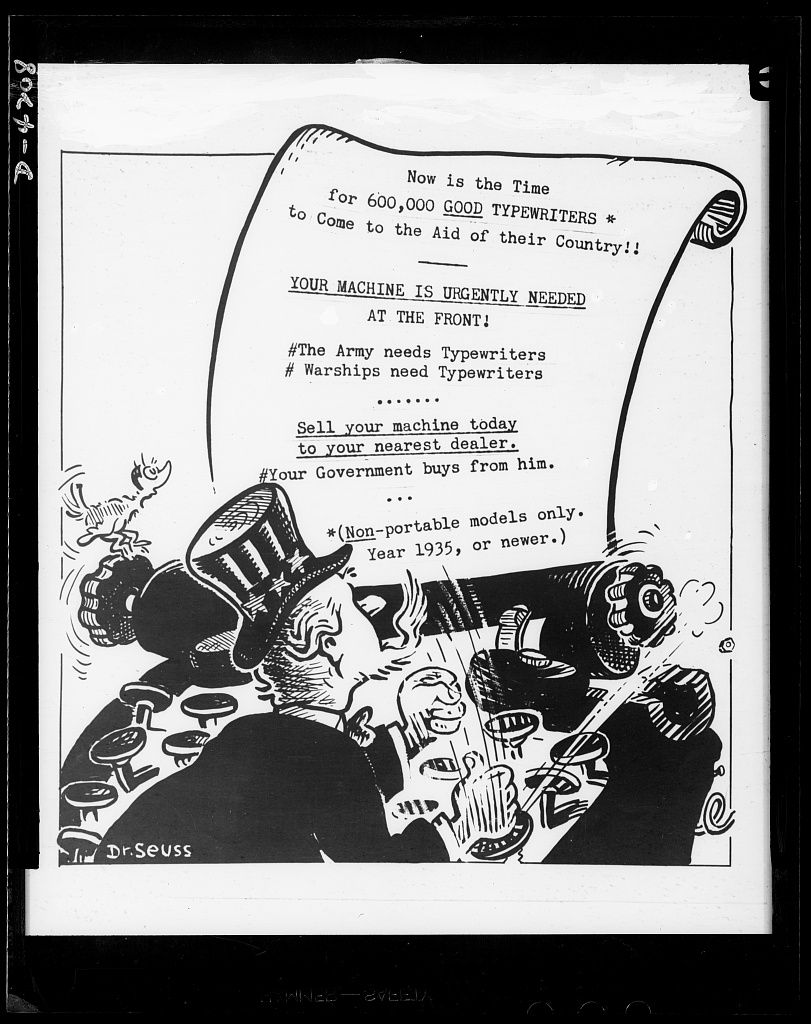
The government needed roughly 600,000 machines. Army, Navy, Maritime Commission, half a dozen other agencies running typing pools with nothing to type on. That figure isn’t secondhand. It’s printed directly on a recruitment poster the Office of War Information put out that same July: “Now is the Time for 600,000 GOOD TYPEWRITERS to Come to the Aid of their Country.” Below that, in smaller type: “Your machine is urgently needed at the front. The Army needs typewriters. Warships need typewriters.” Sell it to your nearest dealer, the poster says, and the government will buy it.
The poster was drawn by Dr. Seuss. He was working for the OWI at the time, years before the children’s books, doing the same kind of wartime propaganda work that pulled illustrators out of magazines and advertising firms all over the country. It’s a strange thing to sit with, the future author of The Cat in the Hat drawing Uncle Sam sounding the call for used typewriters.
We’re Buying ‘Em!
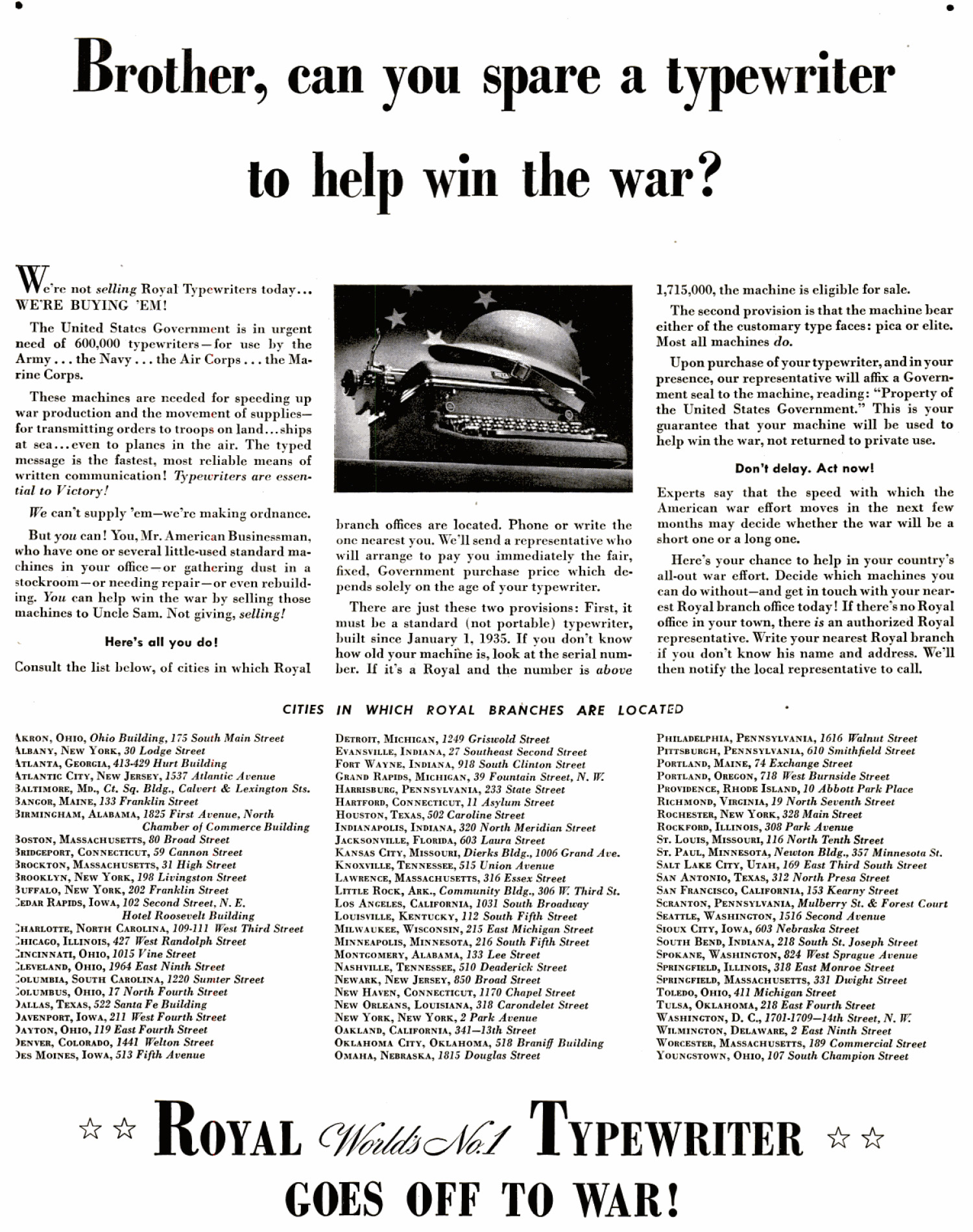
There wasn’t a single dollar figure behind “the fixed rate.” Royal and Smith-Corona both ran magazine ads that same year explaining the actual mechanism, and it was a formula, not a price tag: any standard typewriter of their own manufacture, built since January 1, 1935, would be bought back at that machine’s own 1941 trade-in value, whatever condition it was in. What Stockham’s typewriter fetched depended on what a dealer would already have offered him for it the year before Pearl Harbor. The government didn’t set a price, it just paid the going rate.
Royal ran its ad in Life on August 24, 1942, headed “Brother can you spare a typewriter to help win the war?” “We’re not selling Royal Typewriters today,” it read. “WE’RE BUYING ‘EM! The United States Government is in urgent need of 600,000 typewriters, for use by the Army, the Navy, the Air Corps, the Marine Corps.”
Smith-Corona ran its version a month later: buy back every standard machine built since 1935 “at standard 1941 ‘trade-in’ values,” and keep servicing the ones customers couldn’t spare, “for the duration.”
Stockham’s transaction was small, but it’s worth telling in full instead of folding into a general statement about WWII donation drives. He wasn’t a company handing over a fleet of office machines. He was one man giving up the typewriter he probably used at home or at his insurance office. MacDonald wasn’t drafted into this either. He ran a typewriter store, and the government made his shop the local collection point.
Three Factories, Three Directions
The 1946 Remington-Rand Deluxe Model 5 I own was built at Remington’s plant in Ilion, New York. The same plant that became the country’s top producer of the M1911 pistol during the war. Typewriter production there didn’t pick back up until 1946. That’s the whole reason my machine exists in the form it does: not a new postwar design, just Remington resuming the prewar Model 5 almost unchanged, three years later.
Smith-Corona’s plant in Syracuse made something like 64 million parts before the war ended. Bomb fuses. Ammunition. Pieces of the M-209 cipher machine. M1903-A3 rifles, built at a peak rate of 23,000 a month. A typewriter factory, retooled to build bolt-action rifles faster than most dedicated gun factories managed.
Royal didn’t split the difference the way Smith-Corona did. The company stopped making typewriters entirely and spent the war building machine guns, rifles, and aircraft engine parts instead. Nothing new was coming to a shelf until the war was over.
Property of the United States
Not every typewriter stopped being built. The freeze just covered civilian sales. The factories that kept running still gave part of their line over to machines that went straight to a branch of the military, never to a shop shelf.
A handful of those survive with the markings still on them. 1941 Underwood Universals were stamped for the Navy. 1942 Royal Aristocrats were marked simply “U.S. Military.” 1942 Royal Arrows split two ways that same year, one stamped for the Army Medical Department, another for the Navy. 1942 Remington Deluxe Noiseless were built for the Army Signal Corps, and 1942 Remington Model 5s were made for the Navy. By 1943, Smith-Corona was doing the same, a Silent model for the Army and a Standard for the Navy.
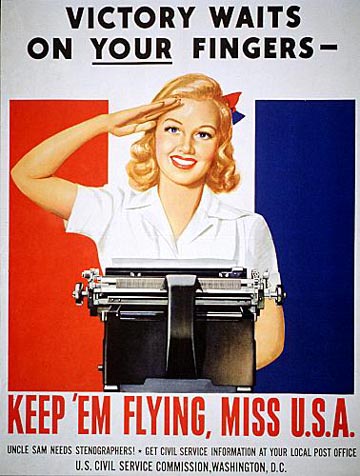
Royal wasn’t finished with typewriters just because it had stopped building them. Around the same period, the company produced a recruitment poster for the U.S. Civil Service Commission. A woman salutes in front of a Royal standard machine, red, white, and blue behind her. The text reads: “Victory Waits on Your Fingers. Keep ‘Em Flying, Miss U.S.A.” Uncle Sam needed stenographers as badly as he needed steel. Royal was still the company putting a face on that particular need, even with its own factory floor given over entirely to guns.
By February 1943, the War Production Board was still asking the public for typewriters. Most major cities were issued a quota after that. By July, a full year after Stockham handed his typewriter across the counter, they were still well short.
I don’t know if they ever hit 600,000. I haven’t found a number that says either way.