Underwood didn’t start as a typewriter company. John T. Underwood built the business supplying ribbons and carbon paper to other manufacturers, chiefly Remington, until Remington started making its own. Underwood answered by buying into a machine, Franz Xaver Wagner’s design, acquired in 1895.
Five years later, that design became the Underwood No. 5. It’s usually credited as the first machine to put the full typed line where the typist could watch it strike the page, instead of typing blind and checking after.
Two million of them sold by the early 1920s. At the Hartford factory, during the run’s peak, a finished machine came off the line about once a minute.
I’ve handled machines from several manufacturers. Not one of them came out of a company that, for a stretch in the 1910s, was outselling every other typewriter maker in the country combined.
From Ribbon Salesman to Industry Leader
The No. 5 made Underwood’s reputation on office desks. Portables came later.
The first version was a three-bank machine, no dedicated number row, in 1919. Remington answered in 1920 with a four-bank portable, full number row included. In 1926 Underwood released its own four-bank machine. They called it, plainly, the Underwood 4.
The 4 still looked like a 1919 design wearing a new keyboard: square-shouldered, upright. In 1931, Underwood restyled it. The casing was rounded, following the softer look Corona had already put on its own portables rather than the squared lines Royal was still using.
Underwood called it the Universal.
They kept refining that same platform, into what collectors now lump together as the Universal-Champion-Leader series: one lineage, three names, depending on the year. Underwood filed this four-bank line, the 4 through the Universal, under one internal letter: Model F. The F series closed out at serial F959243, in 1936. My machine, F889513, was built the same year, near the very end of the run.
Machine Record
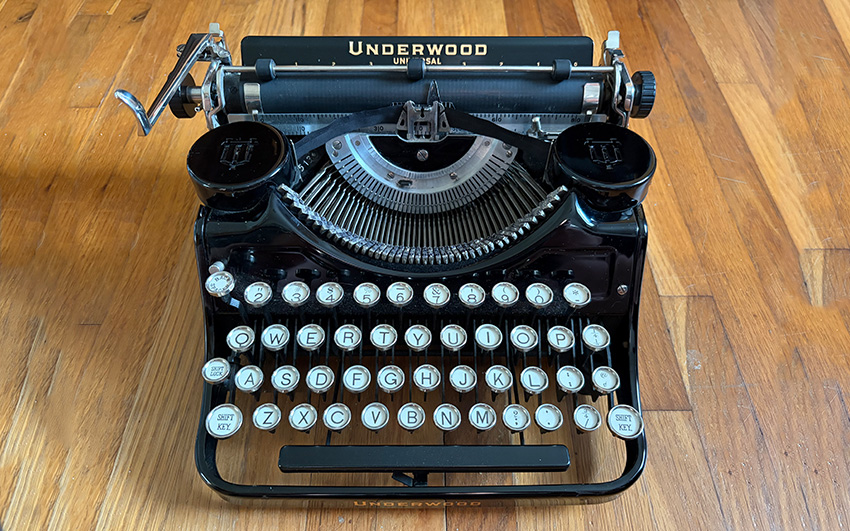
Found this machine at the Springfield Antique Show & Flea Market, one of the largest flea markets in the country, with over 2,000 vendors. I only spotted a few typewriters, and they were pretty beat up. This Underwood Universal was in pristine condition, except for the rubber feet, which need to be replaced.
The price tag read $165. I brought it home for $140.
Aesthetics

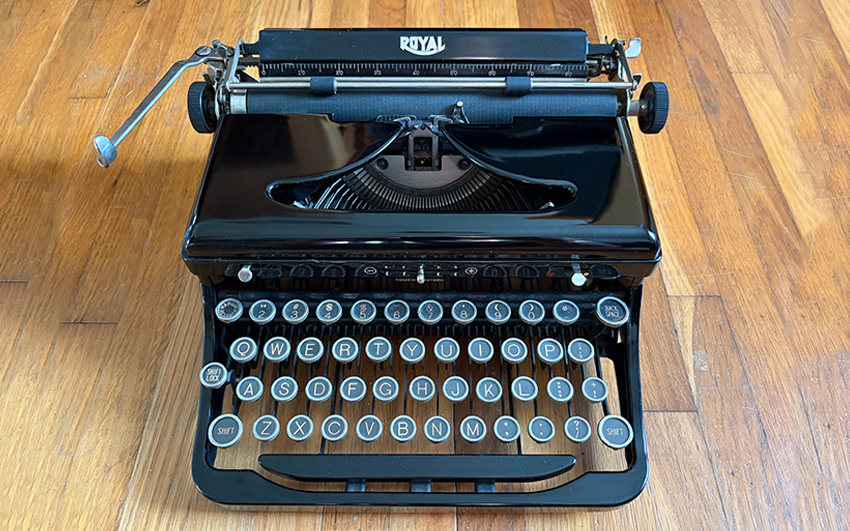
It stands out among many other pre-war typewriters that share a similar profile, like the 1938 Royal Model O. The Universal looks like it’s missing a cover with exposed ribbon spools and open segment basket. It reminds me of a 1930’s hot rod.
All of the gold letter badges on this machine are intact and in amazing shape.
8/10 clacks.
Typing Feel

It’s solid, easy to type on, and the keys are large enough for big hands. It also has a great sound, though mine could probably use a new platen.
This is a carriage shift machine, which is almost always a drawback for me. This one is particularly heavy and not something I would want to type on for extended periods.
6/10 clacks.
Features
There’s no dedicated [1/!] on this keyboard, like nearly every portable of the era. Smaller and stranger is the color-selecting lever, which switches the ribbon between black, red, and a stencil-cutting white. It sits low behind the spools, closer to the ribbon vibrator than to the typist’s hand.
Line spacing is adjustable, single or double, with a separate lever that releases the platen entirely.
6/10 clacks.
Portability

Probably middle-of-the-road as far as size and weight go on these earlier machines.
The case is where this one really loses points. There’s not much to secure the machine inside, and the lock is surprisingly small.
5/10 clacks.
Historical Significance
Underwood built the Model F line for the better part of a decade and sold something close to a million of them, across the 4 and the Universal-branded versions that followed it.
Similar to my Royal Model O, this Underwood Universal has a serial number that dates it near the end of the entire run before the model was discontinued.
6/10 clacks.
Overall
First Underwood. Second pre-war machine in the collection. First one I’ve ever found in the wild, at a flea market table instead of a listing online. All boxes checked, and none of it says anything about the machine itself.
I’ve wanted an Underwood Universal since I started collecting. Every one I came across before this was too far gone: busted keys, too much rust, something. I passed on dozens. This one was in fantastic shape and found its way home.
6/10 clacks.