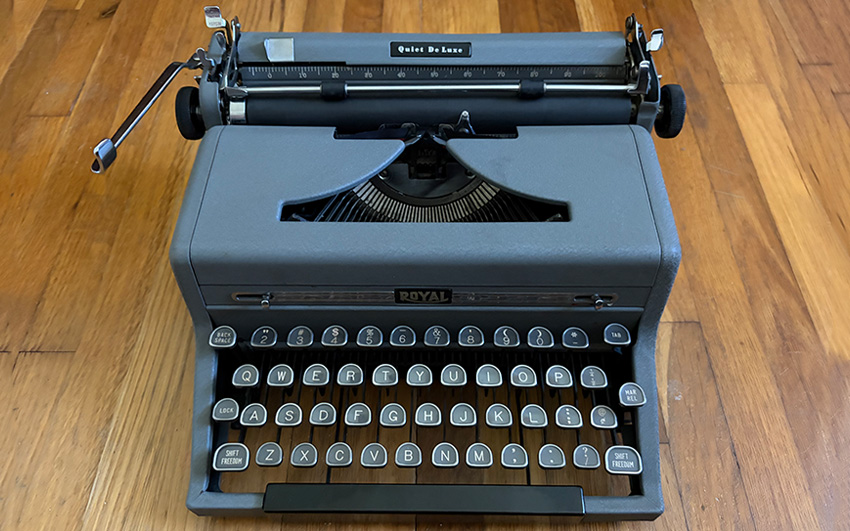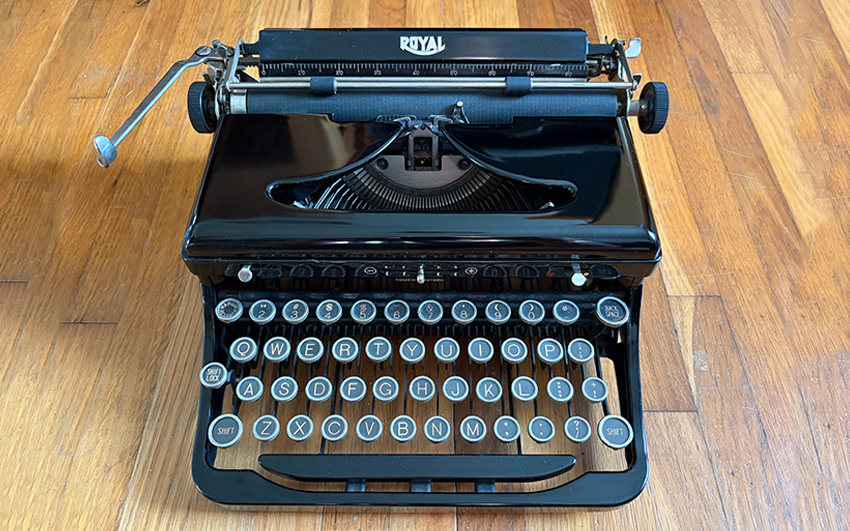
Royal’s first budget portable was the Model P, released in 1926. The Model O replaced it in 1932, and for the next three years the two are hard to tell apart without checking the serial prefix.
Then, in 1935, Royal restyled the shell. The boxy lines went soft and rounded. A lever above the keyboard let a typist dial the key resistance up or down, Royal’s own Touch-Control system. The keys went glass-topped, sold under the name Finger Comfort Keys.
Royal offered the redesigned O in black, and also in purple, green, olive, yellow, red, brown, and maroon. More colors than most portables of the era.
The Year It Ended
Royal’s own dating notes put the Model O’s discontinuation at serial 724093. That’s about thirty-six thousand serials ahead of this machine. Close enough that this one was built in the last stretch of the model’s run.
Around that same time, Royal started something new: the Quiet A, and alongside it, the B model it called the Speed King. The O and a smaller companion, the Junior, were both dropped from the lineup.
A year later, in 1939, the Quiet A merged with Royal’s De Luxe line and became the Quiet De Luxe.
Machine Record
Found this one on Facebook Marketplace for $25. The listing photos didn’t undersell it. The case was beat up, but intact, and the keys worked. There’s an issue with the carriage return, though. I’ll have to dive into that later.
Decades of nicotine had turned to tar across the paint and the glass keys both. It took several days of scrubbing to get this machine back to a glossy finish.
This is the first pre-war typewriter in the collection. I’d been watching for a Model P or O for a while, and $25 for one this complete was not a price I was going to pass up.
Aesthetics

Most of these older machines look about the same. Simple, elegant, classic. Nothing in particular about the Model O stands out above the rest, but I don’t think any collector can deny the allure of glass keys.
7/10 clacks.
Typing Feel

This Model O is a bit snappier than my QDL, but it’s still not a feel that I prefer. I’m finding that most Royal machines have key travel that is too deep for my liking.
5/10 clacks.
Features

Every portable in the 1930s had one selling point built around comfort, and no two companies picked the same one. Royal’s was Touch-Control: a lever above the keyboard that let a typist dial the keys lighter or heavier to match their own hand, no tools needed, paired with glass-topped Finger Comfort keys.
The 1935 restyle that gave this machine its shape and its lever was Royal catching up on looks while getting ahead on touch.
6/10 clacks.
Portability
The Model O is sturdy, but not heavy. It’s a little undersized compared to other portables of the era.
The case is basic, but functional. No overly-complicated locking mechanism to fiddle with.
7/10 clacks.
Historical Significance
Not a rare machine or one that has a lineage of famous users. Royal built the Model O for six years and sold it in enough volume and enough colors that it turns up regularly today.
What this specific serial number pins down is timing: it was among the last Model O’s ever built.
6/10 clacks.
Overall
Much like the Remington Model 5, the Royal Model O feels at home on any typewriter collector’s shelf.
It’s not rare or flashy. It’s one of those things that serve as a reminder of how well built things used to be. This machine still functions the same as it did in 1938, almost 90 years ago.
Most products today ship with a 90 day warranty and ultimately end up in a landfill after a few years of use.
6/10 clacks.